
The verse was already on the chalkboard when my five-year-old walked to the cubbies, lifted his basket out, and carried it to the big table with both hands like it held something breakable. My three-year-old followed with his own. Nobody asked where the glue stick was. That is what a basket does, and I learned it the long way, over two years at the kitchen table.
The baskets came first. The classroom came later. If you teach at a kitchen table, and most of you do, the basket is the most useful thing you can own, because it lets a table become a classroom in about ten seconds. Here is how I pack one.
Why one basket changes the whole morning
A kitchen table is a busy, loved place. It holds breakfast, mail, and somebody's half-finished puzzle. The basket gives school its own home, so you are not gathering scissors from three drawers while two little boys wait. Everything you need lives in one container, and when the lesson ends, it all goes back in.
It also tells your children something without a word. When the basket comes out, school begins. When it goes away, school is done. Small children feel that edge and rest inside it.
What I put in, item by item
Keep it plain. A basket that is stuffed full becomes one more thing to dig through. This is what mine holds:
- A verse card. One short verse, written large, that we read first. At the table, prop it against the fruit bowl.
- Two picture books. One to read aloud, one for the boys to look at on their own.
- A pencil cup. Six pencils, a few crayons, and nothing else in it.
- Scissors and two glue sticks. Two, so no one has to wait or share in the middle of a cut.
- One folder of the day's work. Just today's pages, not the week's.
- A quiet extra for the three-year-old. A few counting bears or a small lacing card, kept only for school so it stays special.
That is the whole list. If you are tempted to add a fourth craft supply, leave it on the shelf. You can swap it in tomorrow.
The folder is the secret
The folder matters more than any other item. Put in one page per child for the day, and a second only if you know you will want it. A five-year-old who sees a tall stack feels the weight of it. A five-year-old who sees one page feels capable.
For a 3 and 5 year old together, I like work that can be done at two levels. The Pumpkin Size Sort cut and paste activity is a good example. My five-year-old can cut, sort, and say the words biggest, middle and smallest. My three-year-old can simply hold the two extreme pumpkins and tell me which one is bigger. Same page, same table, both boys included.
A five-minute start you can use tomorrow
Here is how I open, and you can do it exactly this way at your table.
- Set the basket in the middle and sit down before the children do.
- Say, "Basket first, then snack." Children love knowing what comes next.
- Read the verse card aloud, slowly, one line at a time. Let them say it back to you.
- Take out one picture book and read it, even if it is only a few pages.
- Hand each boy one thing from the folder and let the work begin.
That takes five minutes, and it carries the rest of the morning. By the time the pencils come out, everyone has heard the Word, heard a story, and settled.
Set the table the night before
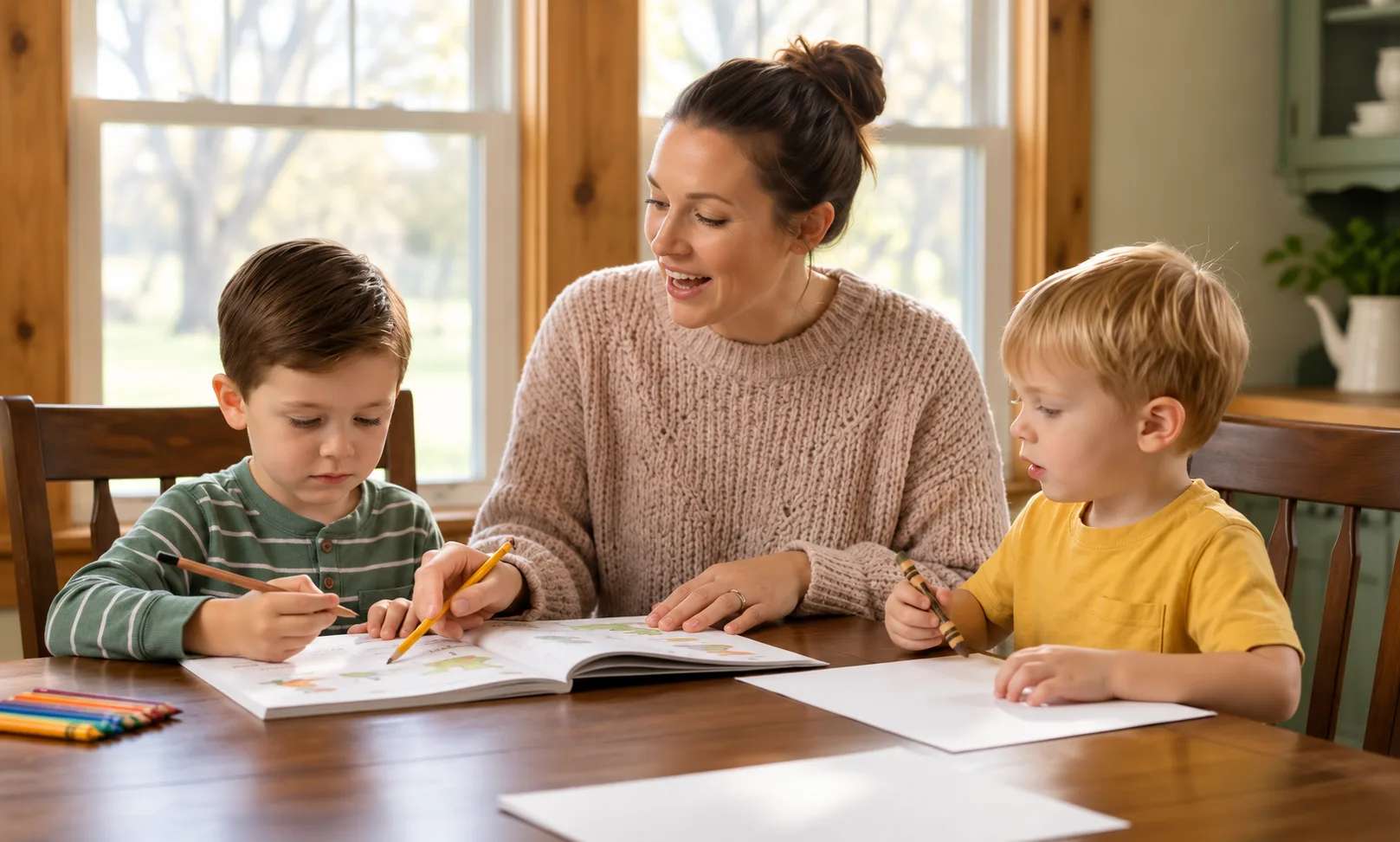
If you are working at the kitchen table, clear one end after supper and set the basket on a chair beside it. You do not need to clear the whole surface. One end, with two stools or chairs pulled close, is enough. In the morning there is nothing to decide. You pour your coffee, sit down, and start.
I would rather you do this small thing than buy anything new. Our classroom design page shows how I arranged the room we have now, but I built that slowly, and the basket habit was the one that followed us all the way. Nothing about it needs a separate room.
Let the basket follow the season
Once the basics are in place, you only need to change the folder and the books. In autumn, I tuck in leaves we collected on a walk and set out the Fall Leaf Stamping activity pack for an art morning. On a slower day, the God's Beautiful Creation leaf crafts let us talk about the Maker while our hands stay busy. You will find more in the worksheet shop, and members pay $2.00 instead of $4.00.
Membership is free, forever, and when you join the list of members, you get 21 free printables, including a morning basket guide that walks through this same idea in more detail.
The Friday reset
Once a week, empty the basket. Wipe the pencil cup, sharpen what needs it, pull out the finished pages, and put the books back where they belong. Then load Monday's folder. It takes ten minutes, and it is one of the kindest things you can do for next week's version of yourself. Some Fridays I will admit I forget, and Monday still works, just a little more slowly. The basket is there to help, not to scold.
A basket will not make every morning go smoothly. It will make your mornings more peaceful, and it teaches your children that learning has a place, a rhythm, and a beginning. You are not setting up a display. You are making a little order so that love has room to work.
"Let all things be done decently and in order." Pack the basket tonight, mama, and let the morning take care of itself.