
On Monday I wrote a tall number 1 on the chalkboard, right under the verse and the date, and my 3-year-old looked at it and said, "That's a stick." I told him he was exactly right, and that today the stick had a name.
That is how Week 1 of our math begins. Four days, one number, and nothing more than that. If you have ever felt the pull to rush into counting to twenty, I want to give you permission to stay with the number 1 for a whole week. We do, and it is one of the happiest weeks of our year.
Why one number gets four days
My boys are 3 and 5, and they share the same table in our classroom. The 5-year-old is ready to write his numbers. The 3-year-old is ready to notice them. A single number lets both of them be right at the same time. I do not need two lessons. I need one lesson with two doors into it.
For two years we did all of this at the kitchen table, and it worked beautifully. If that is where you teach, clear one end the night before and set out one basket, and you have everything the week asks for. The room does not make the lesson. The rhythm does.
Day 1: meet the number
We start at the chalkboard. I say, "This is the number one. Watch my finger." I trace it slowly, top to bottom, and then each boy traces it in the air with me. We say it together: one, one, one.
Then comes my favorite part. I ask, "Can you find one of something in our room?" The 3-year-old brings me one stool. The 5-year-old finds one lamp in the reading nook. We stand and look at it together. That is the whole lesson, about five minutes, and it counts.
Day 2: one of each
On the second day we play with the idea instead of the symbol. I put a small pile of blocks in the middle of the table and say, "Give me one." Then I say, "Now give your brother one." Hearing the word and handing over exactly that amount is real math, even though no pencil is involved.
Try this tomorrow morning with whatever you own. Put out a bowl of buttons, dry beans or crayons and say only these three things:
- "Show me one."
- "Is that one or more than one?"
- "Can you put one in my hand?"
A 2-year-old can do this. A 7-year-old will find it too easy and will want to be the one asking the questions, which is a nice way to let an older child lead.
Day 3: the pages, and the pencil
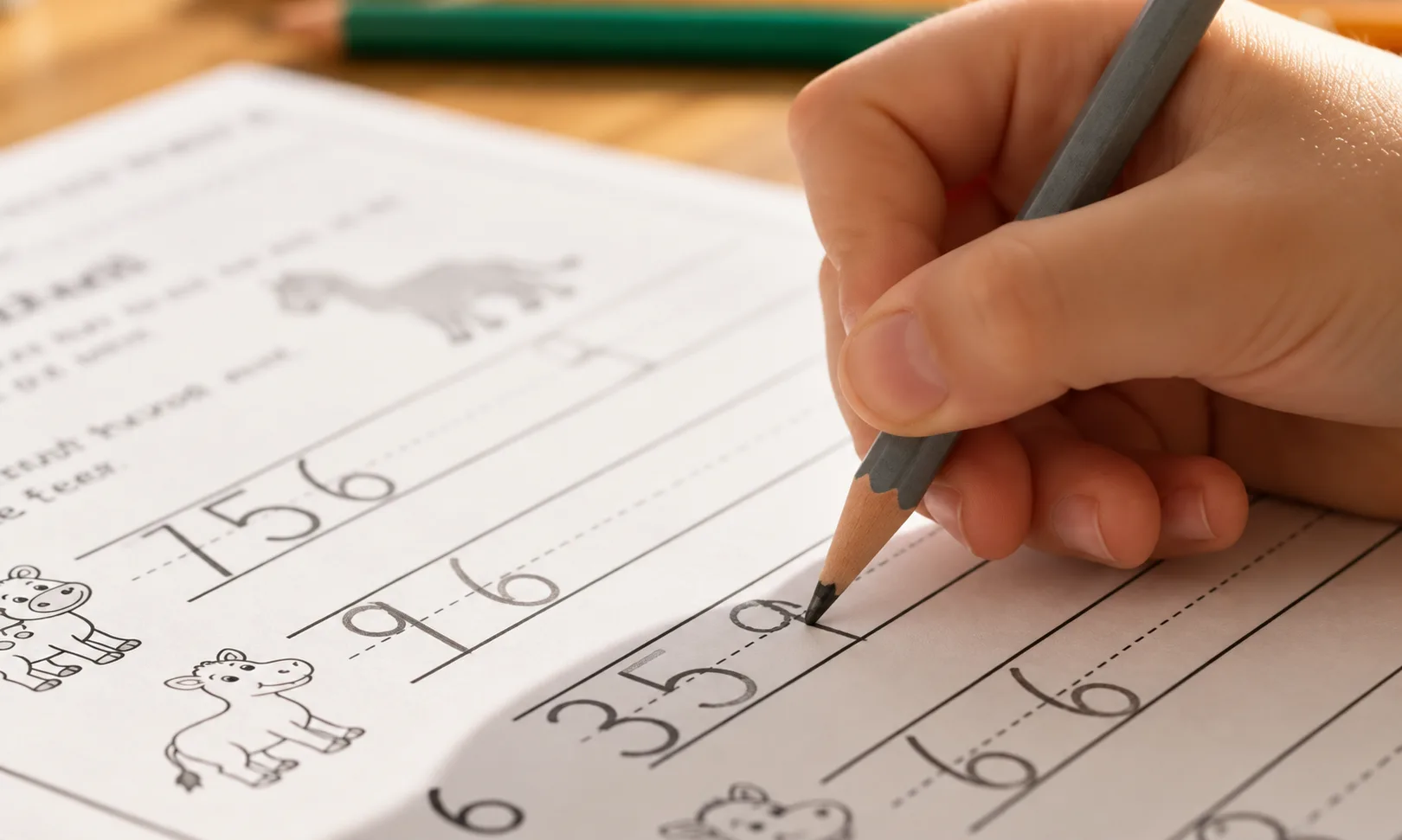
Day 3 is when the printed pages come out. I clip the week's work up on the wall where the boys can see what is coming, and each of them takes their page to their own small desk. The 5-year-old traces and writes his 1s. The 3-year-old gets a chunky crayon and the freedom to make whatever marks he can. I do not correct his number. At three, holding the crayon and sitting with the work is the lesson.
While they work, I sit down nearby with my own coffee and say very little. I have learned that the less I hover, the longer they stay. If a boy gets stuck, I trace the number lightly on the back of his hand and he copies the feel of it. We stop when the page is done, even if there is room left over.
Day 4: say it, find it, celebrate it
The last day is review without any pressure. I write the number 1 on the chalkboard again, and this time the 5-year-old writes it himself while his brother watches. Then we go on a number hunt. We look for a 1 on a clock, on a book spine, on a calendar. We walk the house with a small basket and bring back one thing each.
We finish in the reading nook. I choose a picture book and we read it with the lamp on, then ask each other, "How many of us are sitting in this chair?" The 3-year-old always answers "one" and then squeezes in beside me anyway.
Where the Week 1 pages come from
Every worksheet in our worksheet shop is a print-at-home PDF on US letter paper, and each costs $4.00, or $2.00 for members. Joining is free, forever, and it takes 50% off every worksheet. Members also get 32 free printables, so you may find you are not buying much at all. If you are still arranging your space, I wrote about designing your homeschool classroom, and there is a table-sized version of everything I describe here.
If a week like this feels too slow, or you wonder whether it is enough, bring the question to the members' forum. There is a room for the hard days, and another for each age. Someone there has stayed on one number a little too long and lived to tell it.
One, and then one more
I used to think the slow weeks were the weeks we were falling behind. Now I think they are the weeks the foundation gets poured. A child who truly knows one will understand two. And a child who knows he is seen, one at a time, will learn a great deal more than numbers.
Jesus told a story about exactly this, about a shepherd who counted his sheep and noticed that one was missing. That is the kind of math I want my boys to grow up inside of. Not a crowd, but a child, known by name.
"What man of you, having a hundred sheep, if he has lost one of them, does not leave the ninety-nine in the open country, and go after the one that is lost until he finds it?" (Luke 15:4)