

Tuesday morning my three year old found a bag of dried pinto beans in the pantry while I was stirring oatmeal. He stood there holding it in both hands, very serious, and asked me what they were for. I turned the heat down low and thought for a second about what to tell him.
Then I handed him a muffin tin and said, put six in every cup. He worked for eleven minutes. Eleven. My five year old came over and started counting them back out into piles of ten. I stood there with my spoon and thought, well, we just did math, and I did not print anything, and nobody was hurried.
That morning changed how I think about math for little boys. I had been picturing something formal. A workbook, a table, a chair, a child sitting still in it. What my toddler actually needed was to move small objects around with his hands while somebody talked to him about numbers.
Why the kitchen works so well
Math for a two or three year old is not arithmetic. It is quantity, comparison, sorting, pattern and one to one matching. Every one of those things is already happening in your kitchen twelve times a day. You are just doing them silently.
The whole trick is to say out loud what you are already doing. When I set the table I used to set the table. Now I say, we need one fork for Daddy, one for Mama, one for you, one for your brother. How many is that? Same job. Same three minutes. But my son is now hearing counting attached to real objects that mean something to him, which is how little children learn anything.
I love this because it is honest work. God gave us bread to break and water to pour and a table to gather around, and He is not too proud to teach a three year old to count in the middle of it. Faithful in the small things. That verse has done more for my homeschool than any planner I have bought.
Five things to do tomorrow morning
These take five minutes or less. You do not need to do all of them. Pick one and do it while the coffee brews.
- Muffin tin sorting. A twelve cup muffin tin, plus dried beans, pom poms, cheerios or pasta shapes. Ask for the same number in every cup, or two colors kept separate. This is the one my three year old will do the longest.
- Set the table together. One plate, one fork, one cup per person. This is one to one correspondence, which is the whole foundation of counting, and it sounds fancy but it is just handing out forks.
- Measuring cups nested. Give him the stack. Let him figure out which fits inside which. Say the words bigger and smaller while he works, and let him be wrong for a while before you help.
- Snack patterns. Lay out cracker, raisin, cracker, raisin on the counter. Say it out loud twice, then stop mid pattern and wait. My five year old finishes it fast. My three year old needs me to say the pattern with him three or four times first, and that is fine.
- Pour and compare. Two clear cups, one tall and skinny, one short and wide. Pour the same water into each and ask which has more. Toddlers will say the tall one every time. You are not correcting them. You are planting a question.
What to actually say
I kept freezing up on the words, so here are mine, plain as they come. How many do you have? Let us count them together. One, two, three. Who has more, you or me? Can you give me two? Now can you give me two more? How many is that altogether?
Count with your finger touching each object. Every single time. If you skip the touching, a three year old will chant one two three four five while pointing at nothing, and he will sound like he can count when he cannot yet. Touch each bean. Say each number. That is the whole lesson.
When to move toward paper
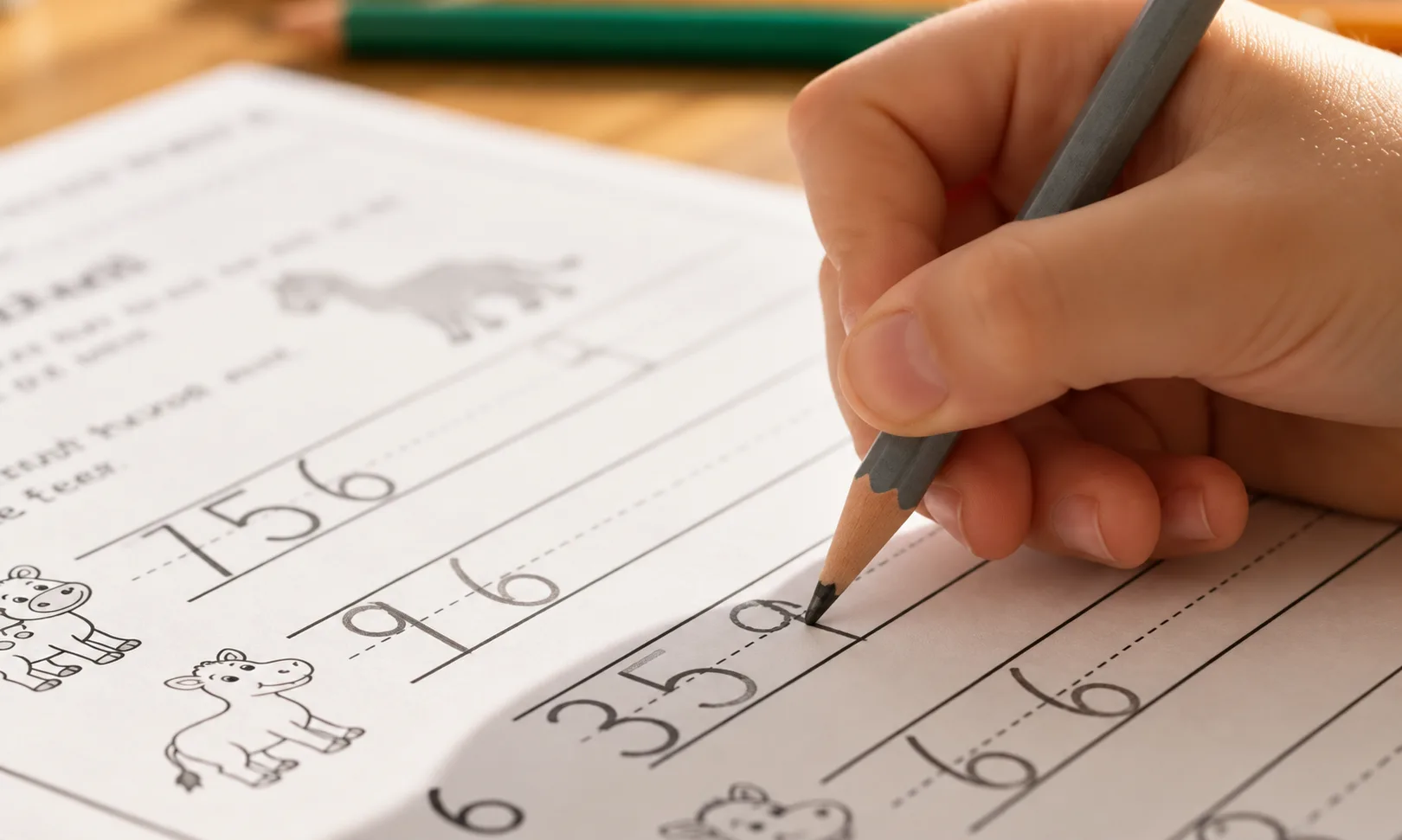
My five year old outgrew beans somewhere around his fifth birthday. He still likes them, but he wanted to see the numbers written down, and he started asking me what shape the number four was. That is the signal. When they ask what it looks like, they are ready to trace it.
That is when a one page sheet earns its place on the big table in our classroom. We used the Woodland Math sheet with patterns, sorting and number tracing after a week of muffin tin work, and it landed because he had already done all of it with his hands. Paper confirmed what his fingers knew. Every sheet in the worksheet shop is four dollars, or two if you are a member, and joining costs nothing ever. Members also get a weekly rhythm chart, a morning basket guide and a nature walk list, plus a quiet moderated forum with rooms by age and one for the hard days, which I use more than I expected to.
The bad mornings still happen
Last Thursday I set out the muffin tin and my three year old threw a bean at his brother and that was the end of math. We curled up in the reading nook with a book instead. I am not a curriculum expert and I have no clever fix for that morning. Some days the kitchen is a classroom and some days it is just a kitchen, and both of those are allowed.
If you are still working out what your days should look like, I wrote about why we do this and the questions I get asked most, and there is a page of resources, curriculum we trust and where to look up your state's requirements, which vary quite a lot depending on where you live. And if you are dreaming about a corner for all of it, setting up a homeschool space was one of the most useful things I did. For two years we did this at the kitchen table, and this past year we finally moved into a classroom of our own. If you are working at the kitchen table, clear one end the night before and set the tin out ready.
Count the forks. Touch each bean. He is learning, and so are you.