
A braid on the table and a 3 on the chalkboard
On Monday morning I wrote a big chalk 3 beside the date, laid three strands of yarn on the shared table, and waited to see which boy would reach for them first. It was my three-year-old, which felt fitting. He is three, and this was his week.
Math Week 3, Days 1 to 4, is all about the number 3, and I want to walk you through how we actually use it in our classroom. Not the ideal version. The real one, with a five-year-old who wants to race ahead and a little one who wants to hold every counter in his fist. Four short days, about ten to fifteen minutes of sitting each, and a lot of three hiding in the rest of the day.
Day 1: See it and say it
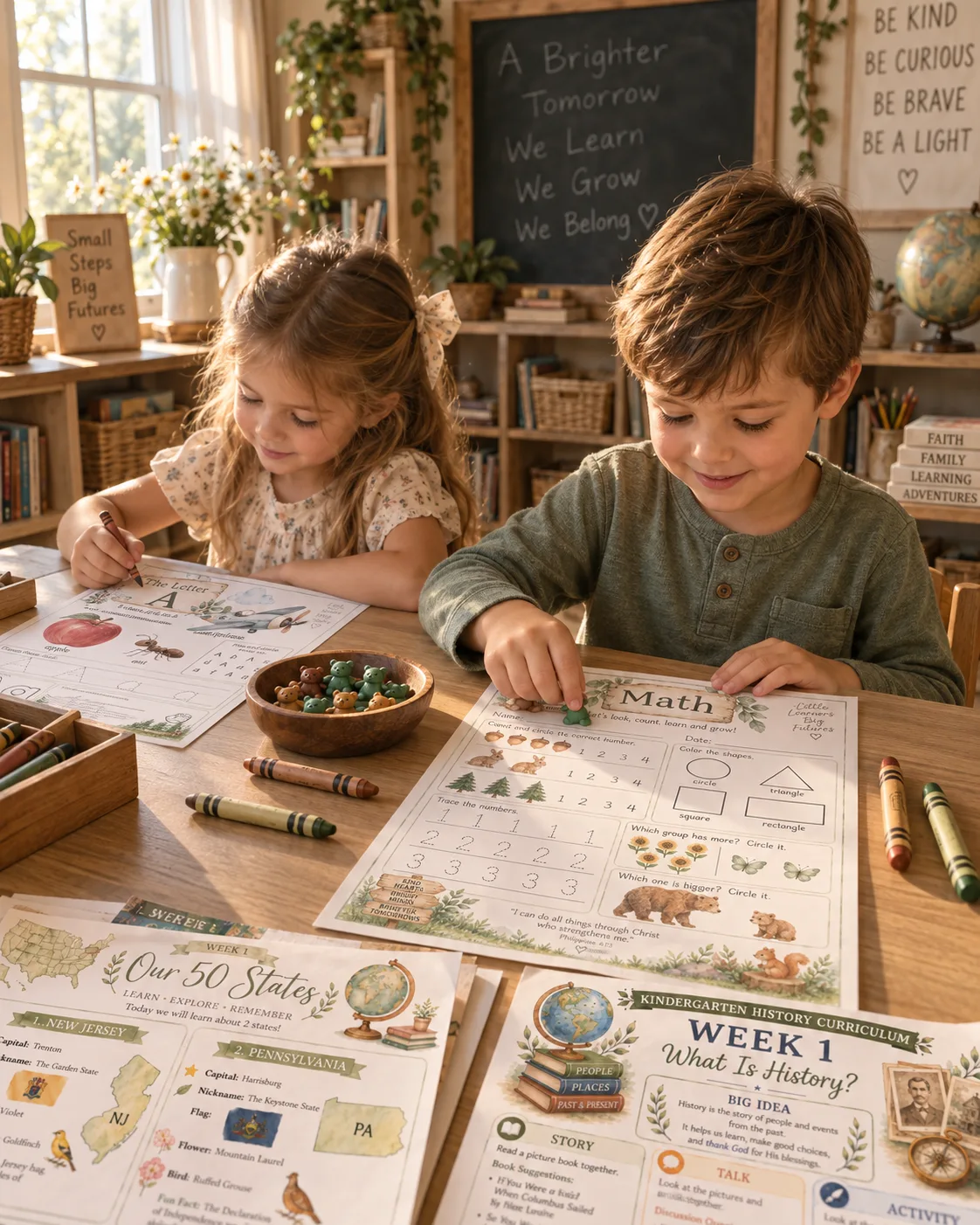
Day 1 is only about meeting the number. I keep the page face down until we have talked. The boys sit on their stools at the big table, and I hold up three fingers.
Here is almost exactly what I say, because a script helps me stay slow:
"This is three. One, two, three. Can you show me three fingers? Now clap three times. Now tap your nose three times. Three is one more than two."
Then we turn the page over. My five-year-old traces the numeral with his finger before he ever picks up a crayon, and my three-year-old colors three of whatever is on the page, even if he goes outside the lines. That is fine. On Day 1 I am not grading anything. I am introducing a friend.
We finish by clipping the page to our work wall so the 3 stays in sight all week.
Day 2: Build it with your hands
This is the day of the yarn. I cut three strands, about as long as my forearm, and tape the tops to the edge of the table. We count the strands together, and then I braid slowly while they watch. Left over the middle, right over the middle.
My older boy can braid with help. My younger one holds the ends and says "one, two, three" each time I cross a strand. Both are doing math. One is working the pattern, one is counting out loud and keeping rhythm, and both see that three things woven together make something stronger than one alone.
This is where I bring in Scripture, and I keep it to one sentence: "The Bible says a cord of three strands is not quickly broken. Let's see if you can snap our braid." They pull. It holds. They are delighted. We talk about how God made us to need each other, how our family is held together, and then we move on. No sermon, just a braid they will remember.
After that, the second page of the week. We use whatever small counters are in the math basket in the cubbies, and each boy builds groups of three before he marks anything on paper.
Day 3: Find it in the world
By Wednesday the boys are ready to get up, so Day 3 starts outside. We take a short counting walk, and the only rule is that everything comes in threes. Three acorns. Three leaves. Three sticks. Three steps on the porch, which my five-year-old noticed before I did.
If you want a little structure for that walk, our fall scavenger hunt for a neighborhood nature walk has picture clues that even a non-reader can follow. I simply ask them to find three of each item instead of one.
Back inside, the treasures go on the nature shelf in rows of three, and then we do the Day 3 page. It goes quickly, because they have just counted to three about forty times without noticing.
Day 4: Write it and tell it
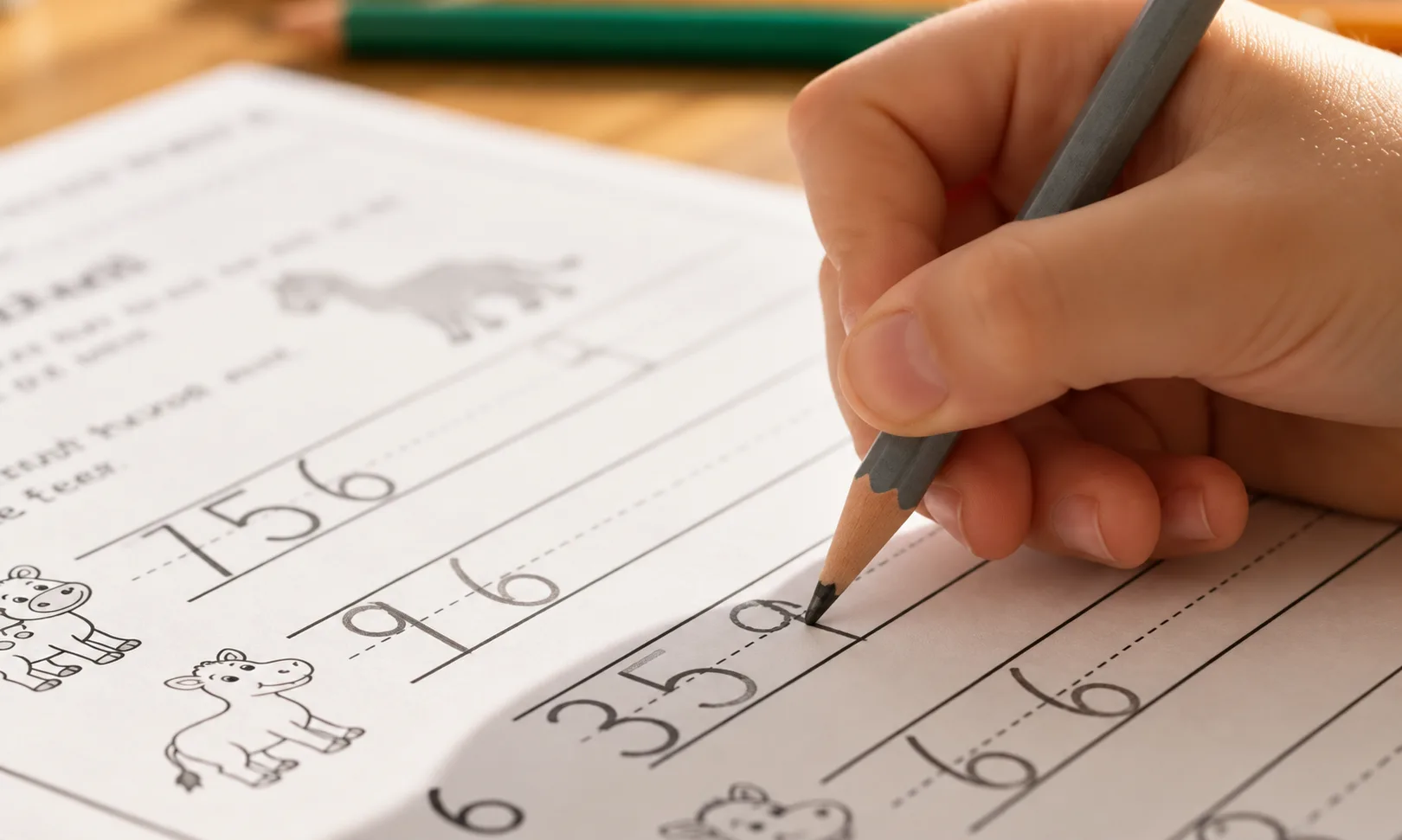
Day 4 is the quietest. Each boy works at his own small desk, the two they asked for once the classroom came together. My five-year-old practices writing his 3 on the page and then on the chalkboard, which he considers a great honor. My three-year-old traces with a thick crayon, and I hold his hand over his the first time.
Then comes my favorite part. I ask each boy to "teach" me three. "Show me three of something in this room." One brought me three books from the reading nook. The other lined up three stools. When a child can hand the idea back to you, it belongs to him.
If your older one is ready for more on Day 4, three is a lovely way into ordering. We sometimes pull out the pumpkin size sort and just use three of the pumpkins: big, bigger, biggest.
Keeping two ages at one table
I will be honest, one morning this week my three-year-old wanted nothing to do with the page, and I let him braid yarn on his own while his brother finished. He came back when he was ready. Short lessons make that grace easy. There is no ground to lose in ten minutes.
A few things that make these four days gentle for us:
- The pages are printed and in a folder the night before, one per day.
- The yarn, counters and crayons live in one basket in the cubbies.
- The chalk 3 stays up all week, so the number greets us every morning.
- Each day ends by clipping the page to the wall, which the boys love.
If you are working at the kitchen table, as we did for our first two years, all of this still works. Clear one end the night before, set the basket there, and tape the yarn to the table edge. I wrote more about setting up a space, big or small, in designing your homeschool classroom.
Where to find the pages
Every worksheet in the worksheet shop is a print-at-home PDF on US letter paper, and each costs $4.00, or $2.00 for members. Membership is free, forever, and it also brings 16 free printables, like a weekly rhythm chart and a morning basket guide. If you want to see how other mamas are pacing number weeks with little ones, come find us in the members' forum, where there are rooms by age.
By Friday, my boys did not just know the number 3. They had braided it, walked it, and handed it back to me. And every time I see that little yarn braid on the nature shelf, I remember what holds our small school together. It is not the pages. It is the Lord woven through the ordinary days, with us.
"Though one may be overpowered, two can defend themselves. A cord of three strands is not quickly broken." Ecclesiastes 4:12