
Last Tuesday my five-year-old asked me if he was alive when the dinosaurs were. He asked it with total sincerity, holding a banana, and I realized he had no working sense of before. Before breakfast, before he was born, before Noah. It was all one smooth fog called "a long time ago."
That is the week I pulled out the History Week 2: My Personal History worksheet and we did it properly, not squeezed in sideways at the end of a math lesson. It took about fifteen minutes at the table and it did more for his sense of time than anything else we have done.
Why personal history comes before anything else
A kindergartner cannot hold 1776. He cannot hold ancient Egypt. What he can hold is the shoe he wore when he was a baby, which is smaller than his hand now, and that shoe is history. It happened. It is over. He was there.
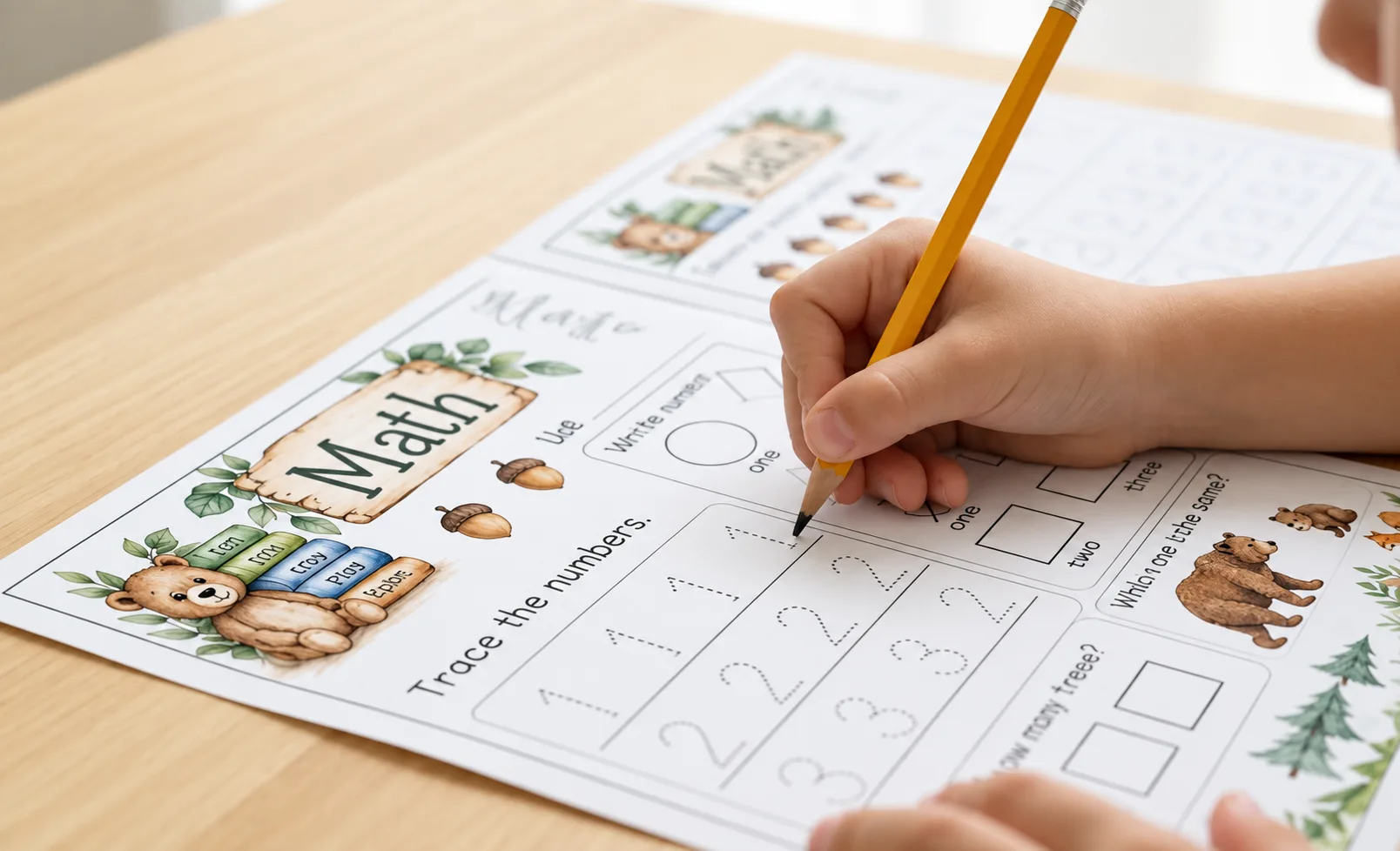
That is the whole idea of the worksheet. There is a short reading passage about what personal history means, a section where he circles the things that belong to his own history, and a box where he draws a picture of himself. One page, printed at home, done sitting down. We had already done the History Week 1: What Is History? page the week before, so he had the word in his mouth already. If you have not done that one, do it first. It is five minutes and it makes this week land.
The shoebox, ten minutes before we sit down
This is the part that made the difference, and it costs nothing. The night before, I went through a drawer and filled a shoebox with things from his life. His hospital bracelet. A pacifier I never threw away. A photo of him at one, cake on his face. The little hat from the day we brought him home. A picture of our old apartment. His first pair of shoes.
In the morning I set the shoebox in the middle of the big shared table in our classroom and nothing else. No pencil yet, no page. He climbed onto his stool and started pulling things out before I said a word, which is exactly what I wanted.
What I actually say
I do not lecture. I ask, and I let him hold the thing while he answers. Here is roughly my script, which you are welcome to steal word for word:
- "Who does this belong to?" Hand him the baby shoe. Let him figure out it is his. Let the silence sit.
- "Were you big or little when you wore this?" Have him try to put it on. The laughing is part of the lesson.
- "Do you remember that day?" He will say no. Say, "That is okay. It still happened. Mama remembers it for you. That is what history is. Things that really happened, even when nobody remembers them but God."
- "What is something that happened to you that you DO remember?" Let him tell you a long, rambling story about the time the dog ate his sandwich. Do not rush him. This is the lesson.
Then I put the box aside and put the page down. He has already done the thinking. The worksheet just gives it somewhere to go.
Working the page itself
I read the passage out loud first, with my finger under the words. Then I have him read it back to me, or track along while I read it a second time slower. He is five. Some weeks he reads three words of it and I read the rest, and that is a fine week.
For the circling section, I say the same thing every time: "Is that yours? Did that really happen to you?" He circles. If he circles something that is not his, I do not correct it like a test. I ask the question again and let him talk himself out of it.
The drawing box is where I stop hovering. He draws himself with arms coming out of his head and I say it is wonderful, because it is. Sometimes I write a sentence under it in my handwriting, whatever he tells me about the picture, and I date the corner. That page goes in a folder. Next year, that folder is his history too.
What the three-year-old does
My little one wants to be at the table. He always wants to be at the table. So he gets his own shoebox items, his own crayon, and a blank sheet of paper. He is not doing the worksheet. He is drawing on paper next to his brother, and I ask him one question: "Were you a baby?" He says yes with enormous pride. That is the entire history lesson for a three-year-old and it is enough.
Some mornings he tips the box over and we are done in four minutes. Those mornings are short, and short is still fine. If you want more on how we set up the big table so both of them can sit, I wrote about how we arranged our homeschool space around that exact problem.
Where this goes next
After personal history, the timeline widens naturally. The Long Ago vs. Today page follows on beautifully, because now he has a real anchor for "long ago" instead of a fog. From there we move outward into place as well as time, and my older boy has been slowly working through the Delaware and Maryland states page with a crayon and the map on the wall.
Every worksheet here is $4.00, or $2.00 if you are a member, and membership is free and stays free. It gets you half off everything in the shop, three printables I use myself, and a quiet moderated forum with a room for the hard days. I have used that room. If you are still deciding whether any of this is for your family, I put our reasons and the common questions here, and if you need to know what your state asks of you, requirements really do vary, so start with the resources page and check your own state's law.
The part I did not plan
When we finished, my son held the hospital bracelet up and asked, "Did God know me then?" And I got to say yes. Before then. Before the bracelet, before the apartment, before any of it.
That is why I think personal history is a faith lesson wearing a history hat. When a child learns that his own small life has a beginning and a shape and a keeper, he is learning something true about the God who wrote it. He is not an accident that started this morning. He was known.
Print the page. Fill a shoebox. Fifteen minutes, one crayon, and a boy who finds out he has a story.