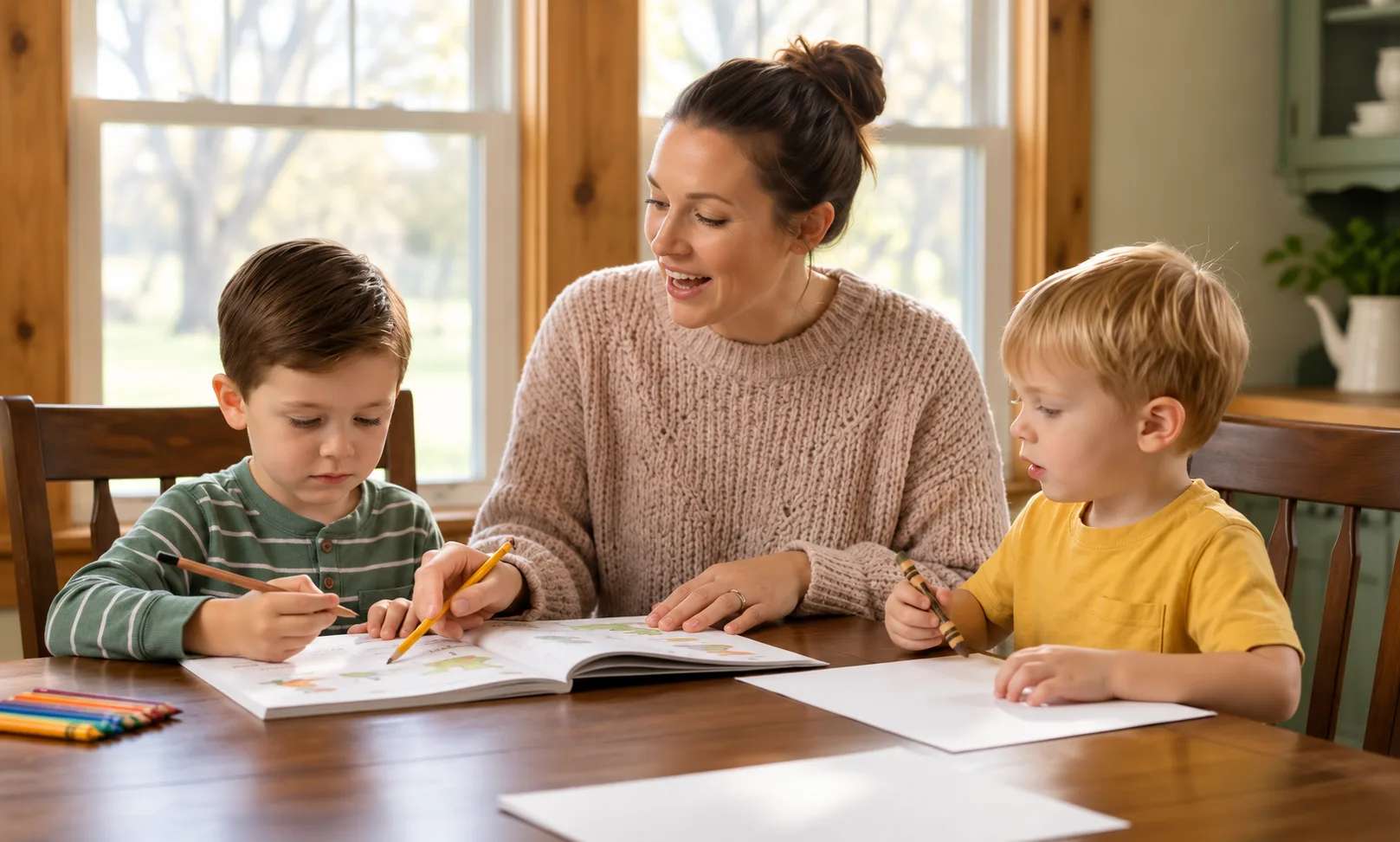
Last Tuesday I kept the plan simple. The classroom was ready from the night before with the verse and the date already on the chalkboard, my five-year-old was asking whether we were going outside, and the three-year-old was standing at the door with his boots on and a bucket. So I said yes, get your brother's jacket, and we went outside with a bucket and no plan beyond that.
We came back in at ten fifteen with eleven acorns, three maple leaves, a chunk of bark, one very dead beetle, and a milkweed pod that had split open. That bucket carried our whole morning. Math, handwriting, a read-aloud, a science conversation, a prayer. I did not print a thing. I want to show you how it works, because a nature walk is not the warm-up to school. On a good day it is the school.
Walk first, teach second
The mistake I made for months was trying to teach while we walked. I would point at a tree and say its name and ask him to repeat it, and he would be halfway down the sidewalk chasing a squirrel. Little boys outside are not in a receiving posture. They are in a gathering posture.
So now the walk has exactly one job: fill the bucket. I give each boy something to hunt for and then I mostly hush. Three things, no more:
- Something that came off a tree. A leaf, a piece of bark, a seed, an acorn cap.
- Something smaller than your thumb. This one keeps my three-year-old busy for a shocking amount of time.
- Something that is a color you like. He will argue with you about colors. Let him.
Forty minutes, or twenty on a cold day. If they ask a question outside, I answer it short and say, "Let's put that one in the bucket and look at it at the table." That sentence is the hinge of the whole morning. It teaches them that their own questions are the curriculum, and it saves the good stuff for when we are sitting down and I can actually think.
Dump the bucket on the table
We come in, boots off, and I dump everything right in the middle of the big shared table in our classroom. For two years we did this at the kitchen table, and it works just as well there. If you are working at the kitchen table, clear one end the night before. Not on a tray, not in a basket. In a pile. The pile is the lesson, and here is the order we go in, because it moves from loud to quiet and that matters with a three-year-old in the room.
Sorting and counting, which is your math
First we sort. "Put all the leaves here. Put all the hard things here." My three-year-old can do this and feel like the smartest person in the house. Then we count each pile and I write the numbers on a scrap of paper where he can see them. Eleven acorns. Three leaves. Which pile has more? How many more? If we have two of something I ask my five-year-old to split them evenly between the two of them, which is division and he does not know it.
Then we line the leaves up from smallest to biggest. Then we trace one with a finger and talk about the edges, smooth or pointy. That is twenty minutes of real math and my hands are free to pour coffee. If your little one likes a page to go with it, the calendar and weather pages in the Morning Menu toddler and preschool bundle slide in here easily, because we have just been outside and we know exactly what the weather is doing.
The one thing we look at closely
Out of eleven acorns and a dead beetle, we pick one thing. Tuesday it was the milkweed pod. I put it in front of my five-year-old and said, "Tell me three things you notice." Not "what is it," because he does not know what it is and neither did I. Three things you notice. He said it was fuzzy inside, it was hard outside, and the fluff wanted to fly away.
Then he drew it. Badly, gloriously, with a brown crayon. I wrote his three sentences underneath while he dictated them, and that is his nature notebook page. My three-year-old scribbled on his own paper and I wrote "milkweed" at the top for him, and then he asked me to write his name, and we did letter sounds on M for about ninety seconds before he was done. Ninety seconds is a win. Take the ninety seconds.
Words, letters and a read-aloud
Whatever we looked at becomes the word of the day. I print it big on a piece of paper: A C O R N. We say the sounds. My five-year-old copies it. My three-year-old finds the letters that are also in his name. If you want handwriting practice that afternoon and the boys are done with nature, this is where I reach for something ready made from the worksheet shop instead of making one up at my workstation.
Then we read. I do not own a perfect book for every seed pod, so I read what we have and let it be adjacent. A picture book about trees. A psalm. Something from the library stack. Nature walks have also become our sneaky doorway into other subjects, because once you have talked about what grows where you live, "what grows somewhere else" is a very short jump. That is how we ended up doing the Delaware and Maryland states page on a rainy afternoon, and how the same walk turned into a conversation about long ago that fit right alongside the Long Ago vs. Today page.
Close it with a prayer, not a lesson
We end with the pile still on the table. I ask one question: "What did God make today that you liked best?" My three-year-old usually says the beetle. Then we thank Him for that one thing out loud, in eight words, and school is over. No wrap-up, no review, no quiz.
I keep the seed pod on our nature shelf until it falls apart. That is our whole record-keeping system, and I will say plainly that requirements vary by state, so check what yours actually asks for. I keep a list of state laws and the curriculum we trust for exactly that reason.
If you want a list to take out the door tomorrow, the nature-walk list is one of the three printables that come with joining free, along with the weekly rhythm chart and the morning basket guide. Membership costs nothing and halves the price of every worksheet, and it gets you into the members' forum, where there is a room for the hard days and I promise you are not the only one in it. Some mornings my whole plan is a bucket and a door. God has been kind about meeting us out there.