
I had Psalm 119:105 written on an index card and propped against the butter dish. "Thy word is a lamp unto my feet, and a light unto my path." My five-year-old got about four words in. My three-year-old said "lamp" with great confidence and then took a bite of toast. We tried it again. Same result. I said it louder and slower, which helped nobody, and by the fourth round I could hear my own voice getting tight.
So I took the pen and crossed out most of it. What was left was "Thy word is a lamp." Five words. Both boys had it before the toast was gone, and the little one said it in the bathtub that night without being asked.
That is the whole thing I learned, and it took me longer than it should have. A little mouth can only hold a little. Not because the child is not capable of Scripture, but because four words that live in him all week are worth more than twenty he stumbles through at the table and forgets by lunch.
What "short enough" actually means at this age
When I am picking a verse for my three-year-old now, I am looking for three things. It has to be short, somewhere around three to six words. It has to be concrete, meaning the words point to things he can see or feel: light, bread, hands, love, good. And it has to be true standing alone, so I am not clipping a phrase into meaning something the passage never said.
That third one matters. "God is love" from 1 John 4:8 is complete. "Be kind" from Ephesians 4:32 is complete. But you cannot take half of a verse about judgment and hand it to a preschooler as a comfort. When in doubt, I read the whole verse out loud to myself first and ask whether the short version is a doorway into the real thing or a detour around it.
Here are the ones that have actually stuck in my kitchen, in case you want to borrow them:
- "God is love." 1 John 4:8. This was my three-year-old's first one, and he still says it in the car.
- "Be kind to one another." Ephesians 4:32. Useful about nine times a day between brothers.
- "I will trust in thee." Psalm 56:3. We say this one at bedtime and before the doctor.
- "Children, obey your parents." Ephesians 6:1. Say it when things are calm, not as a weapon in the middle of a no.
- "Give thanks unto the Lord." Psalm 107:1. Our grace before lunch became this.
- "Thy word is a lamp." Psalm 119:105. The one that started all of it.
- "Let us love one another." 1 John 4:7.
Seven verses is more than enough for a year with a three-year-old. I would rather he own seven than recognize forty.
The five minutes that made it work
We do this right after breakfast, before anything gets wiped down, because that is the one moment my boys are already sitting still. The whole thing takes about five minutes and it goes the same way every single day, which is the point. Sameness is what does the work here, not cleverness.
The script I actually use
I hold up the index card, even though the little one cannot read it, because the card means something is about to happen. Then:
"Listen. God is love." I say it once, plainly, looking at them.
"Now you." They say it. Usually one of them mumbles and the other shouts.
"Again, with your hands." We tap our knees on each word. Four words, four taps.
"Again, quiet as a mouse." They whisper it. Something about whispering makes a three-year-old take a thing seriously.
"Again, big voice." They yell it. The neighbors know us.
Then I ask my five-year-old one question about it, nothing fancy. "Who is love?" Or "Can you tell me somebody God loves?" He usually says himself, then his brother, then the dog. And we are done. I put the card back against the butter dish and we move on to letters or counting.
Five repetitions, four different voices, one question. That is it. If they are already coming apart, we do two repetitions and I let it go. A verse said twice in peace beats five times in a battle, and I have fought that battle and lost it more than once.
What I do when a verse stalls
Some weeks nothing lands. When that happens I stop trying to fix the child and look at the verse instead. Nine times out of ten it is too long, or it has a word he has never heard, or I picked it because I liked it rather than because he could use it.
Cutting it shorter is almost always the answer. "Thy word is a lamp unto my feet" became "Thy word is a lamp," and then, for a while with the three-year-old, just "a lamp." He would point at the ceiling light and say it. That counts. You can always add the rest back next month, and we have. He says the longer half now.
The other thing that helps is putting the verse somewhere other than the table. On the stairs. In the bath. Walking to the mailbox. We say our verse on the way out the door so often that my five-year-old now starts it himself when he hears me pick up the keys. If you keep a rhythm chart going, tuck the verse into a slot you already keep rather than adding a new one. The free weekly rhythm chart you get when you sign up for a free membership has room for it, and honestly that is where ours lives.
Letting it sit alongside the rest of the morning
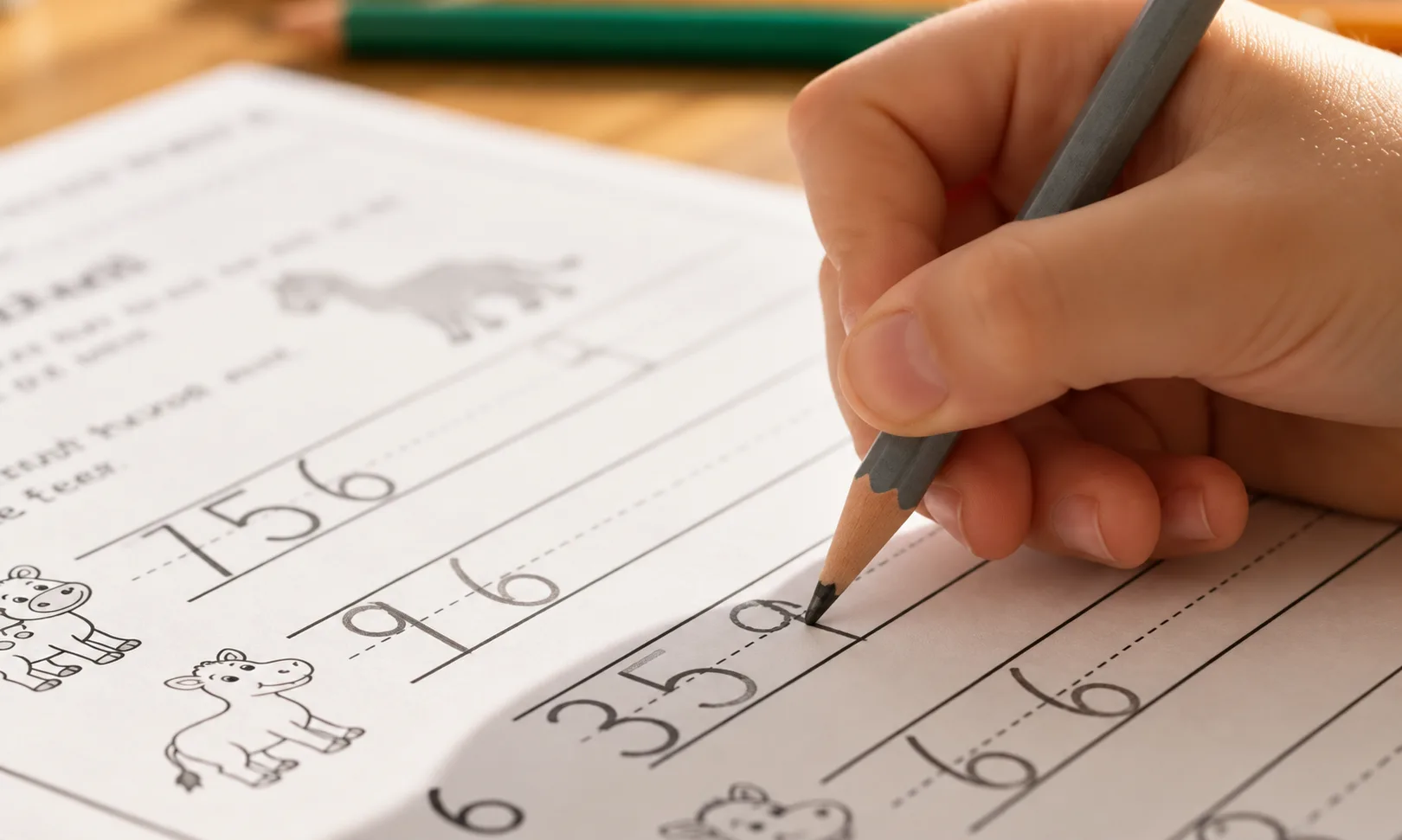
Our verse is not a subject. It is the hinge between breakfast and the rest of what we do, and it is short enough that it does not cost us anything. After we say it, my five-year-old usually gets a page in front of him while his brother colors, something like the Woodland Math page with counting, shapes and tracing or the Letter A page, which my three-year-old mostly uses as a hunting game for circling every A he can find.
I have caught myself wanting the verse time to be bigger and more impressive than it is. Candles, a song, a whole devotional. Some mornings we get there. Most mornings it is an index card leaning on the butter dish and four words, and that has turned out to be the version that lasted. If you want to see how the rest of our table is set up, I wrote about how we arranged our little homeschool space, and there are more pages in the worksheet shop if you are building out a morning.
And if this week feels like it is not working, come say so in the members' forum. There is a room for the hard days and it is not empty. I am usually in there too, on the days when I am the one who needed the short verse more than the boys did.
Four words. Say them five times. Say them again tomorrow. That is all it takes to hide something in a heart that small.