
Monday morning my five-year-old asked if we could do school in the fort he built out of the couch cushions, and I said yes, because the fort was already there and it was a sweet way to begin. We read from the fort. Then we came to the big table in our classroom for the rest, and the whole thing took fifty minutes.
I want to show you a real week, because when I started I kept reading schedules that assumed a quiet house and a child who sat still. My house has a three-year-old in it who comes and goes from the table as he likes. So here is Monday through Friday as it actually happened, with what I said, what we used, and where we let it go.
What a Kindergarten week is really made of
Four things, every day, in the same order: a Bible reading, a math thing, a letters and reading thing, and something to look at or go find. That is it. Forty-five minutes to an hour, and we are done before ten. Everything after that is play, outside, chores, read-alouds on the couch.
The order matters more than the timing. My boys know that after the Bible comes the counting, and after the counting comes the letters. They stopped asking how much longer once the shape of it got into their bones. If you want that written down somewhere you can see it, the weekly rhythm chart is one of the three printables you get when you sign up for a free membership, and I keep mine clipped on the wall beside our chalkboard.
Monday: start with the thing that sets the tone
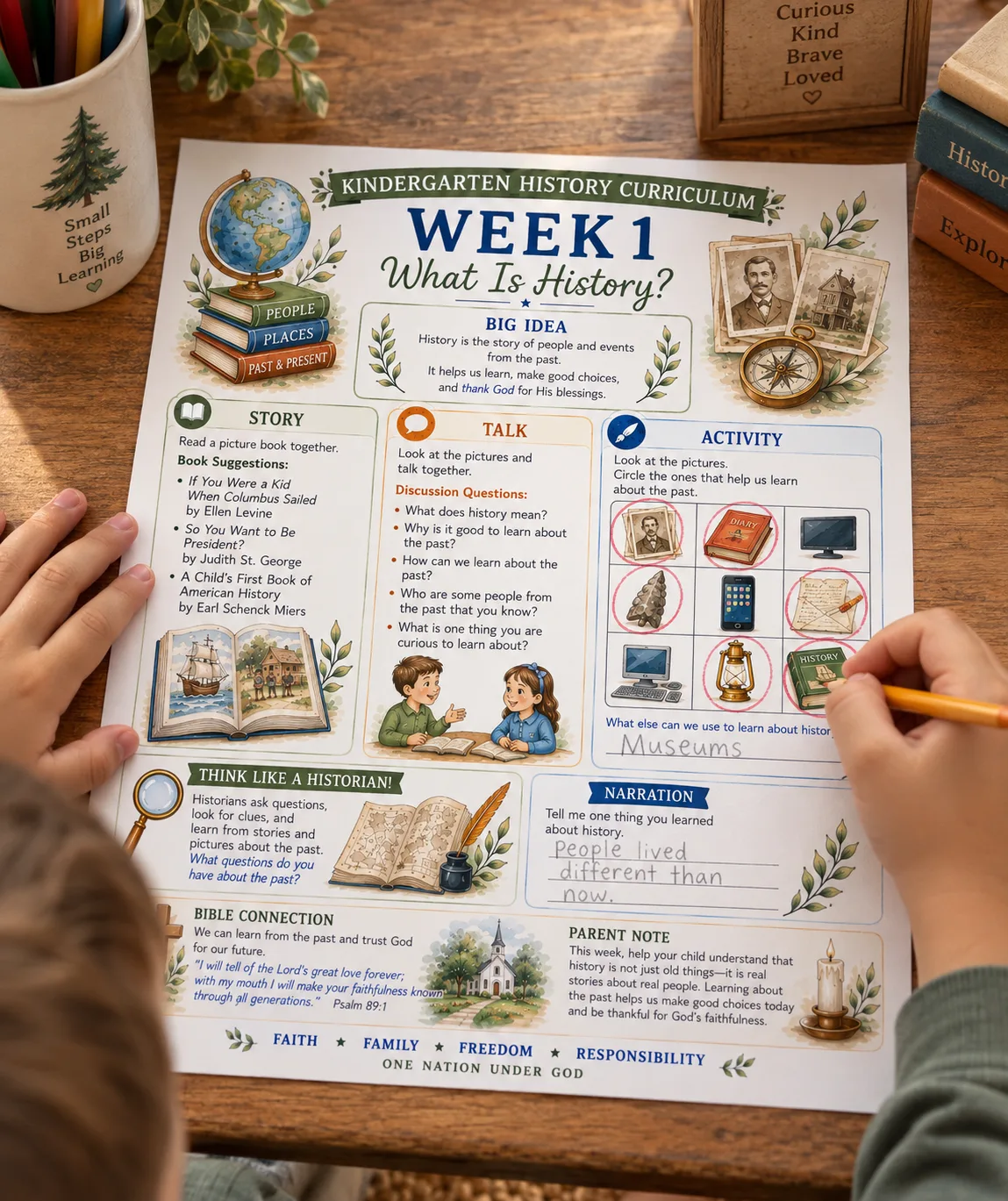
We opened in the couch fort with a psalm and one question. I ask the same kind of question every time, small enough that a five-year-old can answer it: "What did God make in that verse?" or "Who was kind in that story?" My three-year-old usually offers an answer all his own. I say thank you and move on.
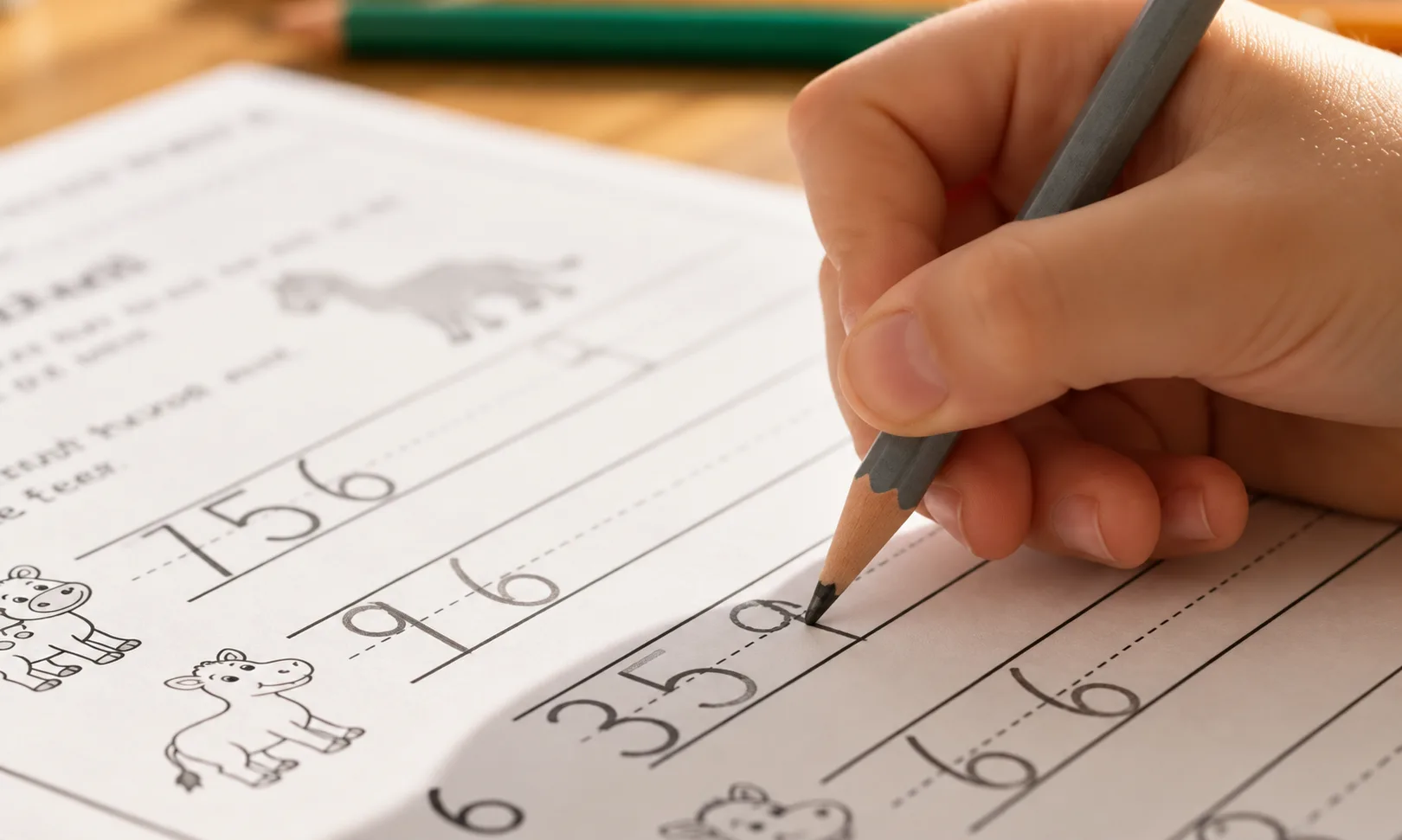
Then math at the big table. Monday is our new-concept day, so we did counting to four with a worksheet and a bowl of dried beans. He counted beans into the bowl, then circled the number. If you want the exact page we used, it is the Math Week 1 counting and numbers sheet, one page, print at home, count and circle and trace. My three-year-old got the beans and a muffin tin, which kept him happily busy for eleven minutes.
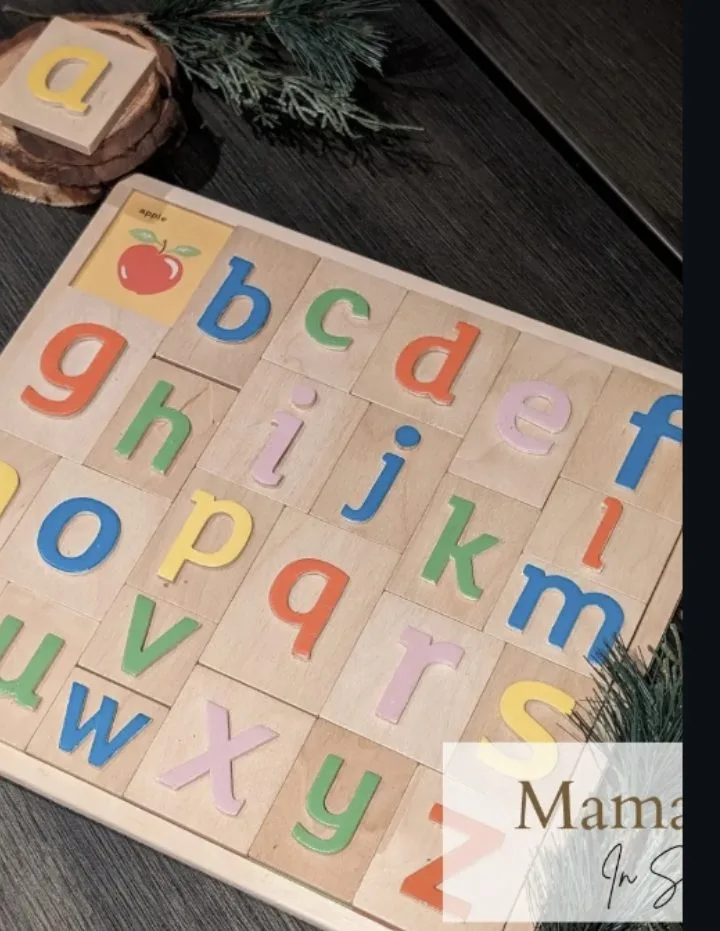
Letters after that. One sound, said out loud, traced in the air, found in a book. Five minutes. Then out the door.
Tuesday: the day we quit early
Tuesday nobody slept well and I was short with both of them before eight. We did the Bible reading and then I closed the book and said, "We are going to the creek." That was school. We looked at a dead crawfish for a long time and came home muddy.
I used to feel sick about days like that. I do not anymore. A Kindergartener needs about twenty minutes of real seat work a day, and the rest of the learning is happening whether I plan it or not. If Tuesday is a wash, Wednesday is right there. That is the whole argument for doing this at home, and I have written more about it in why we think home is the better classroom.
Wednesday: review, and let the little one in
Wednesday is the same math again, on purpose. Same numbers, new beans, no new explaining. Five-year-olds learn by the fourth time, not the first, and a repeat day is the cheapest thing in my week.
This is also the day I let my three-year-old have a real seat and a real page. Not the same page. He gets something to color while his brother works, at the same table, with his own pencil, and six minutes of that is plenty. Here is the script that works for me: "You have a job too. Your job is to color the map while brother counts." Naming it a job does something. He sits taller.
Thursday: the wide-world day
Thursday we do social studies, which at this age means looking at where things are. We are working through the states, two at a time. This week was Delaware and Maryland, with the flags, the state shapes, and finding them on the map to color. My five-year-old wanted to know if Maryland had crabs in it. We looked it up. That was the lesson.
Thursday is short, ten minutes of sheet and twenty of talking. Then we take a walk and I bring the nature list, another of the member printables, and let them tick things off.
Friday: finish light and finish early
Friday we review the week and then bake something. Measuring cups are math. Reading the recipe out loud is reading. We clean up the table together and I put the week's four pages in a folder so their dad can look at them, and so I can see on a hard week that we actually did something.
If you want to copy this week exactly
- Monday: Bible and one question, new math sheet with beans, one letter sound.
- Tuesday: Bible, same letter sound, outside. Keep it short if the night was bad.
- Wednesday: Bible, repeat Monday's math, little brother gets his own page at the table.
- Thursday: Bible, two states with the map, a walk with the nature list.
- Friday: Bible, review, bake something, put the pages in a folder.
A few plain things I have learned
Print Sunday night. I lay all four pages out on my workstation in order, and Monday morning starts ready. Pages are four dollars each, or two if you are a member, and membership is free and stays free, so there is no reason to pay full price. You can look through what is in the shop and pick a week at a time.
Set the table before bed. Two pencils, two erasers, one basket. For two years we did this at the kitchen table, and if you are working at the kitchen table, clear one end the night before. This past year I built our classroom, and I wrote about how we arranged it in setting up a homeschool space that actually works. The short version is that it does not need to be big or fancy to work.
Check what your state asks of you. Requirements vary a great deal and I am not the person to tell you what yours are, but I keep links to state laws and the curriculum we trust in one place so you are not hunting.
And when the week falls apart, say so out loud to somebody. The members' forum has a room for the hard days and it is moderated and quiet and kind. I am in there most weeks. If you want to know who is writing all this, here is a little about me and my two boys.
A Kindergarten week at home is not five perfect mornings. It is four ordinary ones and a creek. I keep coming back to the promise that He is not finished with any of us yet, my boys or me at this table with a warm cup of coffee.