

The candle was lit, the verse was on the chalkboard, and my five-year-old had already pulled his stool up to the big table with the letter page in front of him. His little brother wandered over with his own pencil and asked, "Is that my letter too?" It was. It is the same page, and it is how we handle almost every letter in our room.
Mamas keep asking me how I use the letter sheets, so here is the whole thing. One page, three days, about ten to fifteen minutes each. Nothing fancy, and nothing to hunt for.
Why one page and not three
When I first started, I thought a new letter meant a new stack of paper every day. It only made us rush. A child does not own a letter after one look. He owns it after meeting it again, a little differently, a few days in a row.
So we keep one page and let it change jobs. Monday it is for looking and saying. Tuesday it is for writing. Wednesday it is for finding the letter out in the world. The page stays clipped on our weekly wall the whole time, so the boys can walk up and touch it between lessons.
Day one: look, say and trace with a finger
We start at the chalkboard. I write the big letter and the little letter, and I say its name and its sound. Then I say one word that starts with it and the boys give me another. A three-year-old's word does not have to be right. "B, b, bear!" and "B, b, bus!" are both wonderful.
Then we sit at the shared table with the page. Nobody picks up a pencil yet. We trace the letter with a pointer finger, and I say the strokes out loud: "Down, up, around." My five-year-old does it with his eyes closed once he is confident, which he finds very funny.
That is all. Five to eight minutes. Clip the page up and stop while they still want more.
Day two: pencil, and a different job for each boy
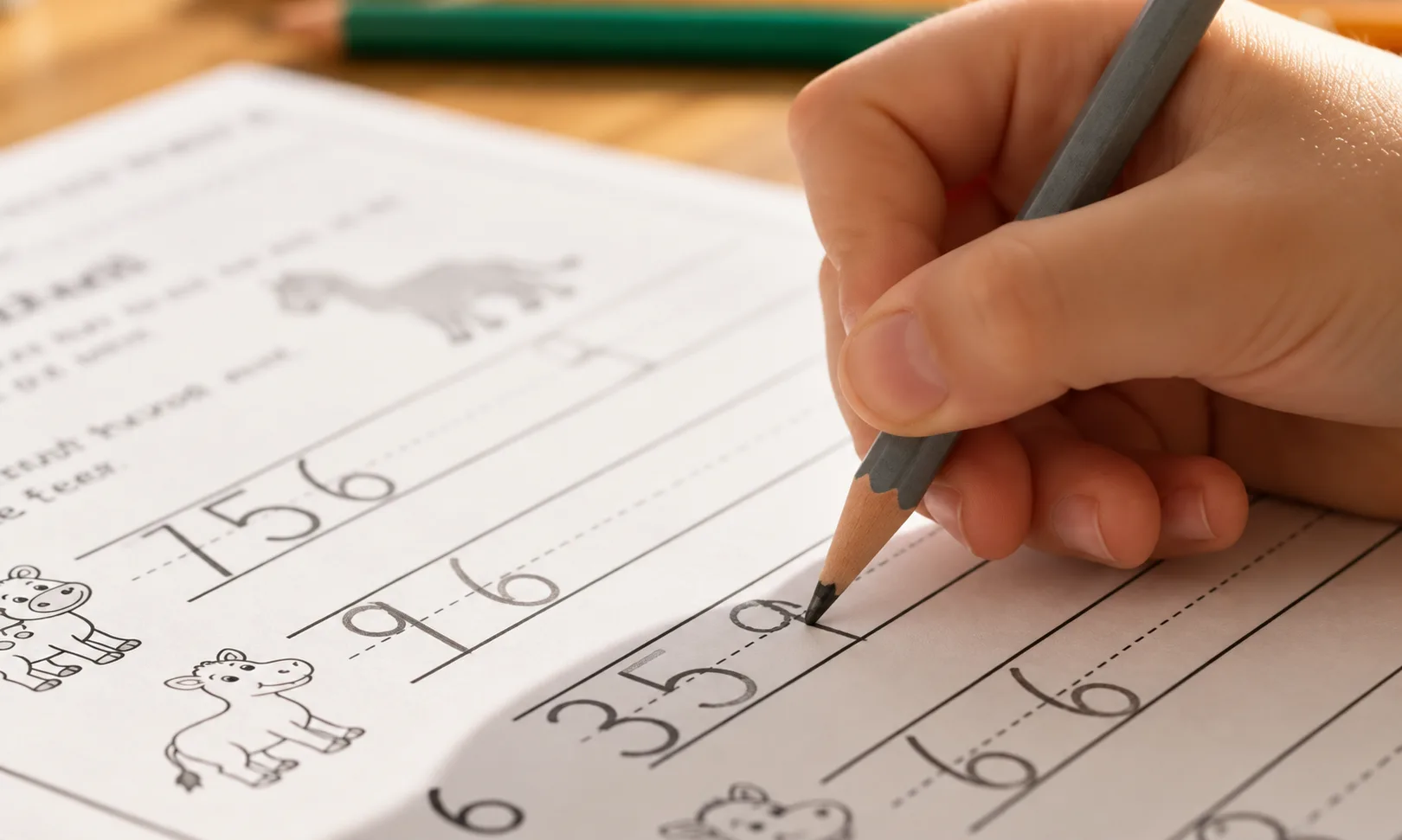
This is the writing day. My five-year-old traces and then writes the letter on his own, a row of it, and I praise the one that stands up best, not the whole row.
My three-year-old uses the same page but with an easier job. He traces just one or two with a fat crayon, or he draws the letter in a small tray of salt at his place. If he only wants to color the picture on the page, that is a perfectly good Tuesday. His hand is getting ready.
If you are working at the kitchen table, you can do this the same way. Put the page in the middle, give each child a cup with their tool, and sit on the side where you can steady a small hand. For two years we did it exactly like that, and the letters came.
A script that helps
When a child is frustrated with a wobbly letter, I say, "Let's make it again together, slow." I do not say "that's wrong." Then I put my hand over his and we go down, up, around. We try it once more by himself. Then we stop.
Day three: hunt it, then make something
The last day is my favorite. We take the letter out of the page and into the room.
- Take a highlighter or a crayon and circle every copy of the letter on the page.
- Go to the reading nook and find that letter on the covers of the picture books facing out.
- Walk the room for things that start with the sound: something from the nature shelf, something in a cubby.
Then we finish with a small hands-on page that matches the letter. It makes the whole week feel like one little story. For P we might do the pumpkin size sort cut and paste. For G, the cotton ball ghost craft is a gentle giggle. For L, there is the fall leaf stamping pack, and for F, the fall colors leaves page has name and date lines the five-year-old can practice on. Not every letter has a perfect match, and that is fine. Use a picture book instead.
Setting it up so you are not scrambling
The reason this feels calm is that the work is ready before we sit down. The night before, I print the page, clip it to the wall, and set a pencil and a crayon in each boy's basket. That is the whole prep. If you want ideas for arranging a room like this, I wrote about designing your homeschool classroom, but a basket and a cleared end of a table will do the same job.
Every worksheet in the worksheet shop is a print-at-home PDF on US letter paper. They are $4.00 each, or $2.00 if you are a member. Joining is free, forever, and it gives you half off every page, plus 22 free printables to begin with. If you want to talk through your own letter weeks with other mamas, the members' forum has rooms by age.
What I have stopped worrying about
I used to worry about pace. Was a letter a week too slow? Too fast? Now I watch the boys. If Wednesday goes well, we may add a second letter. If the letter is still slippery, we give it another day on Thursday. Requirements for how and what you teach vary by state, so check the resources page for where to start with that. Inside your own home, the schedule is yours.
I also try to remember what these letters are for. One day my boys will read the Bible for themselves, and the little b and d they argue over now will be the first steps. We are not just filling in a page. We are teaching them to see by the light of the Word.
So tomorrow, print one page. Light a candle if you like, and trace the first letter with your child's finger. Then come back to it the next day. "Your word is a lamp to my feet and a light to my path."