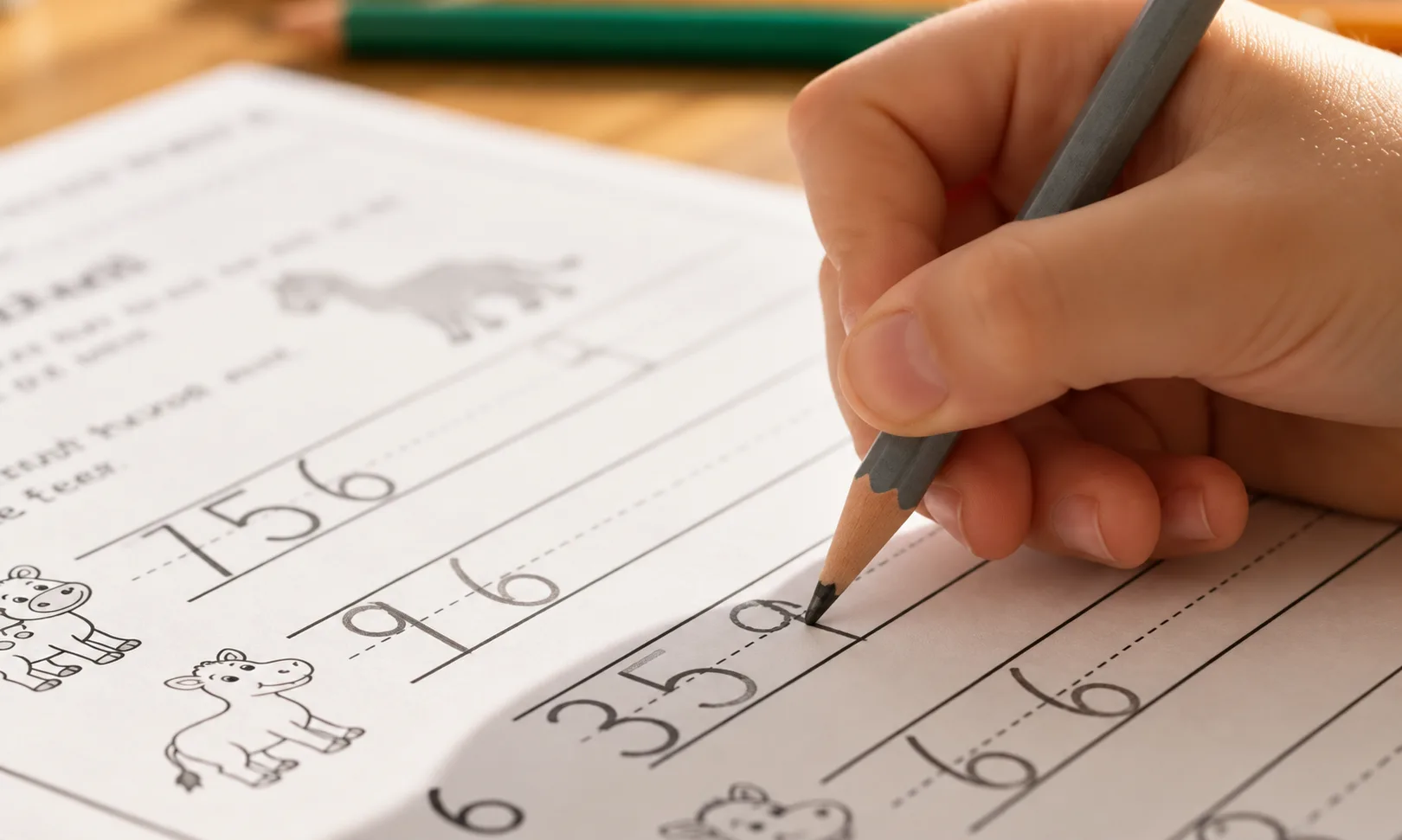

The candle was lit, Psalm 147:4 was written on the chalkboard in my slanty chalk letters, and my five-year-old was already sitting on his stool at the big table when I set down two copies of our Fall Number Recognition Counting Worksheet and a small wooden bowl of acorns we had gathered the afternoon before.
That is honestly most of what this post is about. One page, two boys, one bowl of acorns, and a way of using the same worksheet so both of them are really learning, not just one learning while the other waits. I am not a math curriculum expert. I am a mama who has sat at a table with a three-year-old and a five-year-old enough mornings to know what holds their attention and what gently lets it go.
Why we use one page for both boys
When I first started, I thought each child needed his own separate lesson. So I would teach one and try to keep the other busy, and both of them could tell they were getting half of me. What changed things was realizing that a simple counting page can be read at two levels at once. The page asks a child to find a number and count the fall pictures that go with it. My older son can do both parts. My younger son can do one part with my help. Same paper, same table, same fall morning.
There is something sweet in that for me, too. God did not give me two boys so I could run two classrooms. He gave me brothers who get to sit side by side and watch each other grow.
How my five-year-old uses it
For my Kindergarten-age son, the worksheet is mainly about recognizing the numeral and matching it to a quantity. I let him lead. He points to a number, says it out loud, and then counts the pictures with his finger touching each one. Touching each object matters more than I expected. When he rushes, he double counts. When he touches, he is right almost every time.
Here is the little script I use when he gets one wrong, because I want correction to feel safe:
"Let's count it together, slow like a turtle. Touch and say. One... two... three. What did we get? Is that the same as the number, or different?"
He fixes it himself most of the time. I would rather he find the mistake than have me hand him the answer.
How my three-year-old uses it
My three-year-old is not ready to recognize every numeral on the page, and that is fine. His job is the acorns. I point to one picture group, and he places one acorn on top of each picture. Then we count the acorns together. He is learning one-to-one correspondence, which is a big phrase for a simple idea: one thing, one number word.
Some days he wants to color the leaves instead. Some days he stacks the acorns into a tower. I have made peace with that. If he stays at the table for eight minutes and counts to three with me twice, it was a good math morning for a three-year-old. That one bit of honesty aside, most mornings he is proud to be doing "big brother work," and he tells me so.
A five-minute setup you can do tomorrow
If you want to try this with your own little ones, here is exactly how I set the table the night before so the morning feels calm:
- Print two copies of the page, one per child, even if the younger one will only use half of it.
- Fill a small bowl with ten counters. Acorns, dried beans, pebbles or buttons all work.
- Set out one crayon per child, not the whole box.
- Write a counting verse on a chalkboard or a sticky note, something like Psalm 147:4.
- Decide ahead of time where finished pages will go, so the ending is as simple as the start.
In the morning, we read the verse together first. I tell the boys that God knows the number of every star and calls each one by name, and that today we get to count a few of the things He made, too. Then we begin. The whole lesson is about ten to fifteen minutes for my older son and less for my younger one.
If you are working at the kitchen table
For two years we did all of this at the kitchen table, and I want you to know it worked beautifully. If that is where you teach, clear one end the night before and leave the worksheet, the bowl and the crayons waiting there. A small tray keeps the acorns from rolling off. Today we have a counter-height shared table in our classroom, and I love it, but the table was never the thing that made the lesson good. If you are dreaming about a dedicated space someday, I shared how ours came together in designing your homeschool classroom.
Where the page goes afterward
When the boys finish, the pages get clipped up on our work wall for the week. My five-year-old likes to show his daddy at dinner. My three-year-old likes to point at his acorn-smudged page and say "I counted." Both of those feel like wins to me.
Then we usually head outside. Counting on paper leads so naturally into counting in the yard, and the Fall Scavenger Hunt nature walk printable gives the boys sixteen real things to look for. On a slower afternoon, we might pull out our pumpkin size sort so my younger son can practice biggest to smallest with scissors and glue, or use leftover leaves for the God's Beautiful Creation leaf crafts.
Every worksheet in the worksheet shop is $4.00, or $2.00 if you are a member. Membership is free forever, and when you join free you also get our growing set of free printables, like the weekly rhythm chart and morning basket guide, plus a place in the members' forum, where mamas swap ideas by age and by season.
What I hope you take from this
You do not need a separate plan for every child to teach math well at this age. You need one good page, something to touch and count, and a little time sitting close together. Let the older one lead. Let the younger one move acorns. Let the verse set the tone.
When my boys count acorns, I think about how much bigger God's counting is. He is never overwhelmed by the number of anything, stars or children or mornings. He determineth the number of the stars; he calleth them all by their names.