I wrote MISSOURI on the chalkboard in my slowest capital letters, lit the candle by the nature shelf, and my five-year-old climbed onto his stool at the big table to see what the word was. "That one is long," he said. It is. That was the whole beginning of our geography lesson, and it was lovely.
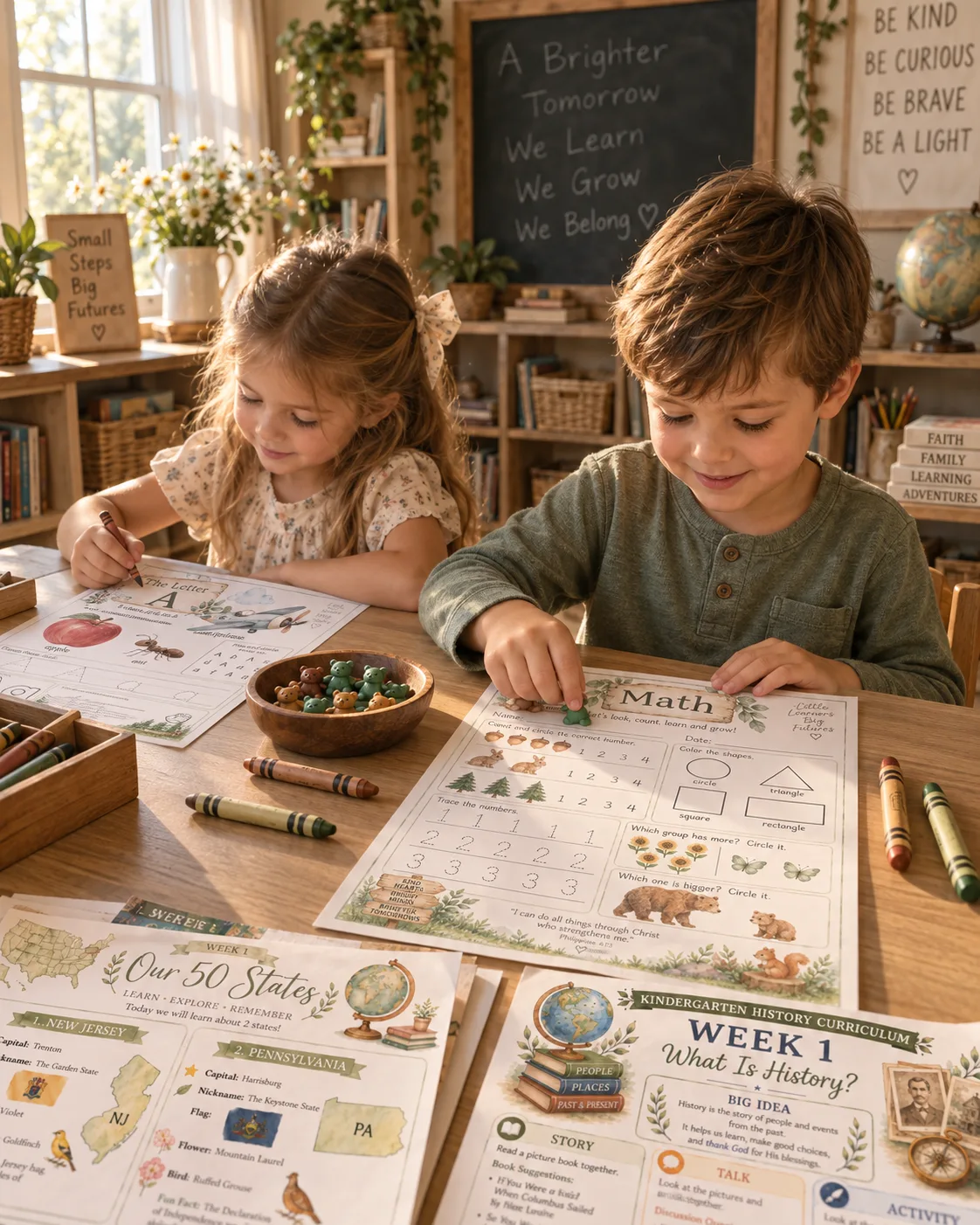
We are in the middle of Our 50 States: Weeks 7-10, a Kindergarten social studies set. It includes three worksheets: Missouri & Arkansas, Kansas & Nebraska, and South Carolina & Georgia. I am not a curriculum expert, so I will only tell you what we do with it and why it works in our room.
Three worksheets, four weeks, no rush
Weeks 7 through 10 is four weeks, and there are three pairs of states. I did not try to squeeze them into a tidy schedule. We take one worksheet a week and keep the fourth week loose, for going back to the state he liked best, reading one more picture book, or simply catching our breath. A five-year-old does not need to cover the map. He needs to enjoy looking at it.
The worksheets are print-at-home PDFs on US letter paper. I print the week's pages on Sunday night and clip them to the wall where we hang the week's work, so on Monday morning the lesson is already waiting at his height.
Our ten-minute state routine
The same few steps every time. Repetition is what makes it feel calm to him, and to me.
- Write the state names on the chalkboard beside the verse and the date. He reads them with me, letter by letter.
- Find the state on a map. Any map works, a wall map, an atlas from the library, even a printed one. He finds it with one finger and I find it with mine.
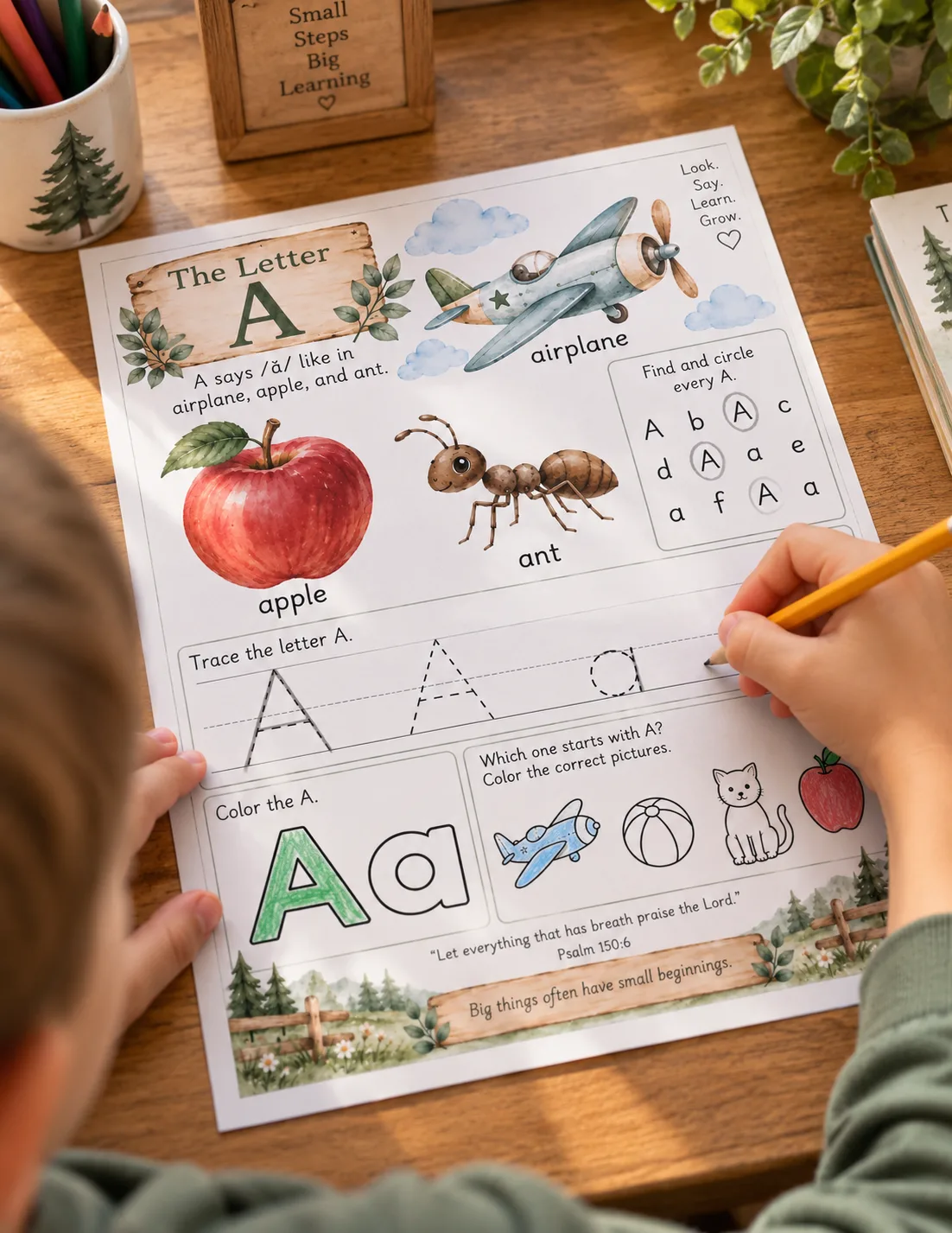
- Do the worksheet page together at the shared table. I sit beside him, not across. I read the directions once, then let him work at his own pace.
- Read one picture book from the reading nook, a library book about a place or a people from that state if we have one.
- Pray for the state. We name it out loud and thank God for the people who live there.
Here is the script I use at the map. "Today we are visiting Arkansas. Put your finger on it. Now put your finger on where we live. Which one is farther away?" That small question gives him something to think about, and it takes under a minute. Tomorrow morning you can do exactly that with nothing but a map and a pencil.
What the three-year-old does
My younger boy is not doing state worksheets, and I do not ask him to. He comes to the table with a job of his own. Some mornings he stamps while his brother works through a state page, using the Fall Leaf Stamping Printable Activity Pack. Other days he sorts pumpkins with the Pumpkin Size Sort, biggest to smallest. When we want something very simple, we pull out Fall Colors: Leaves Are Falling All Around, and he colors maple leaves in red, yellow, orange and brown.
He still hears every state name. He says "Nebraska" with great authority and no accuracy, and I have decided that counts.
If you are teaching at a kitchen table
For two years we did all of this at the kitchen table, so I promise you do not need a classroom. Clear one end the night before. Tape the state names to the wall or the refrigerator door where your child can see them. Keep a basket beside your chair with the worksheet, a pencil, a map and the library book, so that you never have to hunt for anything while the candle is burning. If you do want ideas for setting up a space of your own someday, I keep them together on the classroom design page.
What it costs, and how to pay less
Every worksheet in the worksheet shop is $4.00, or $2.00 for members. Membership is free, forever, and takes 50% off every worksheet. When you join free, you also get 45 free printables, including the weekly rhythm chart and the morning basket guide, which pair well with a unit like this. Members also have a moderated forum, and there is a room for the hard days if you ever need one.
Why we bother with a map at five
Some people ask whether a five-year-old is too young for geography. Your state requirements and your own sense of your child will guide you, and the resources page is the place to check on state laws. For us, the point is simple. These states are real places with real families in them, and my boys are learning that God's world is bigger than our street.
That is what I want sitting in the middle of our mornings. Not a list of capitals to memorize, but two little boys looking at a map with wonder, and a mother who is not in a hurry to finish. When we close our books I point at the whole spread of states clipped to our wall and we say the verse together.
The earth is the LORD's, and everything in it, the world, and all who live in it. (Psalm 24:1)