
The candle was lit, the verse was on the chalkboard, and my five-year-old was in the reading nook choosing a picture book while his little brother climbed onto his stool at the big table. That is an ordinary morning in our classroom now, and it did not happen by luck. It happened because the three-year-old already knew what his hands were going to do.
If you are teaching a five-year-old with a three-year-old beside you, I want to tell you what changed things for us. We stopped trying to keep him busy and started giving him work of his own.
Busy is not the same as given work
For a long time I thought of my youngest as the interruption. I would hand him something to "keep him occupied" and hope. It never lasted, because a three-year-old can tell the difference between a distraction and a job. He wants to be part of the morning. He is watching his brother be a student and he wants to be one too.
So now I think of him as a student with a shorter day. His work is smaller and more physical, but it is still work, and I treat it that way. He has a place at the table, a basket that is his, and a start and a finish.
Keep him at the table, not away from it
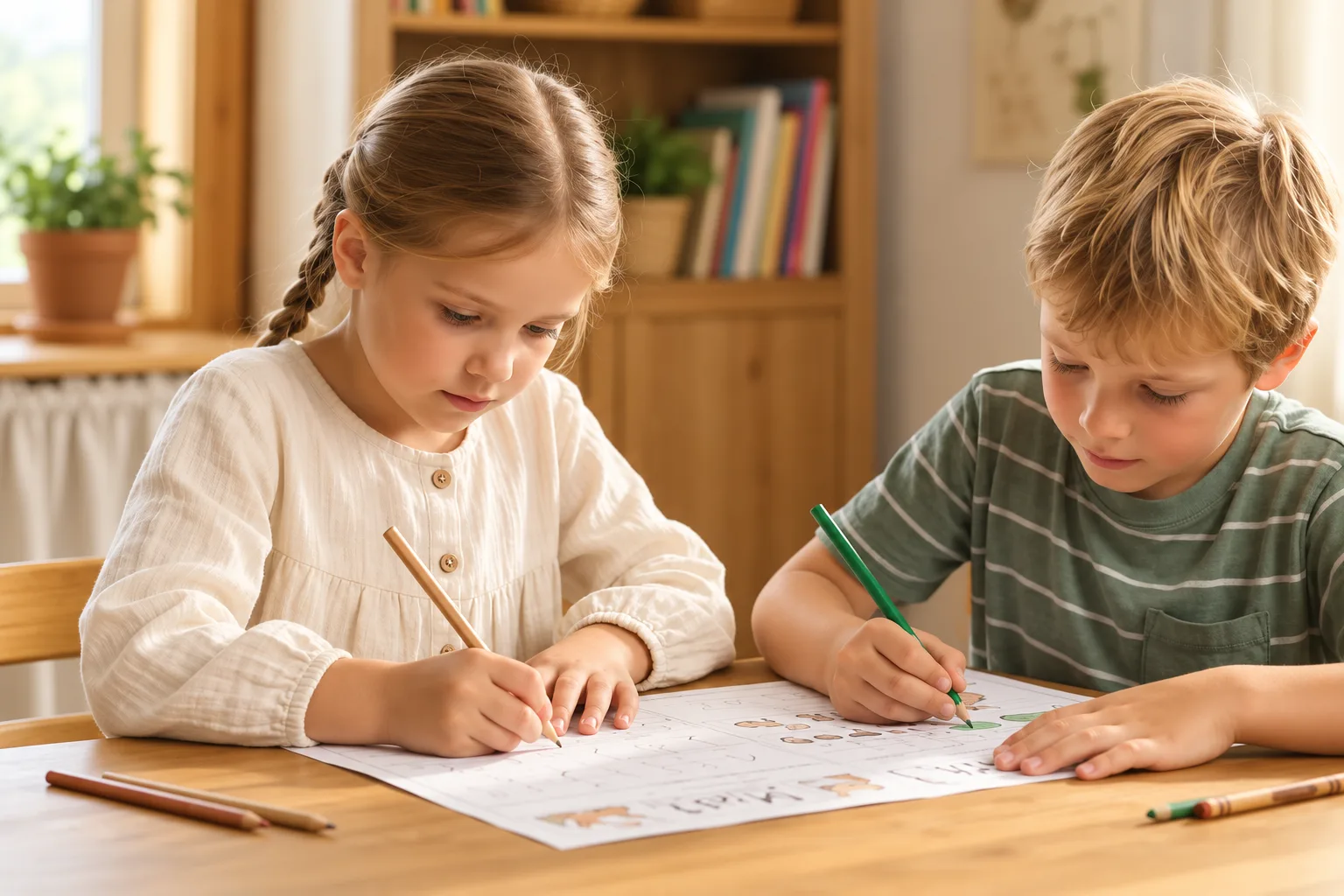
Sending a toddler to another room sounds peaceful, but it usually makes him louder. He would rather be near you. In our classroom the shared table is counter height with stools, so both boys work side by side while I sit between them or just across. The older one has his page, the younger one has his tray.
For two years we did all of this at the kitchen table, and it worked well. If that is where you teach, clear one end the night before and put the toddler's basket at that end, so he sits within reach of you and the lesson. You do not need a classroom for this. You need a spot that is his. If you are curious how I laid ours out, I wrote about designing your homeschool classroom, but the principle is the same at any table.
The basket that only comes out at lesson time
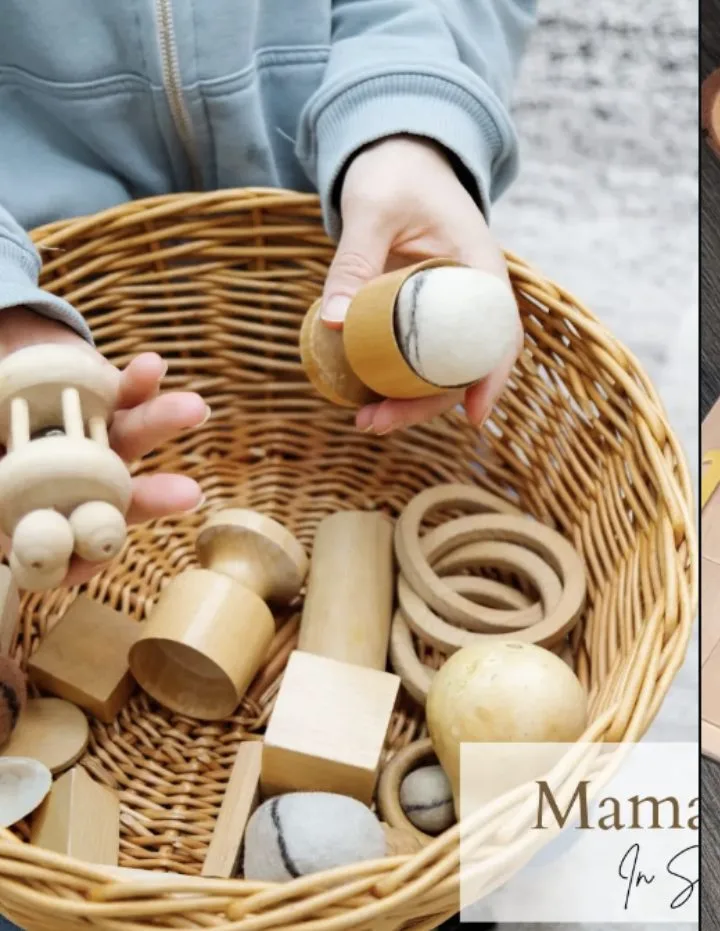
This is the part that does the most work. Keep one basket, or two, that your three-year-old only sees during the older child's lesson. Because it is special, it holds his attention longer than the toys he has all day. Change what is inside every few days, not every morning.
Five-minute jobs that fit a basket
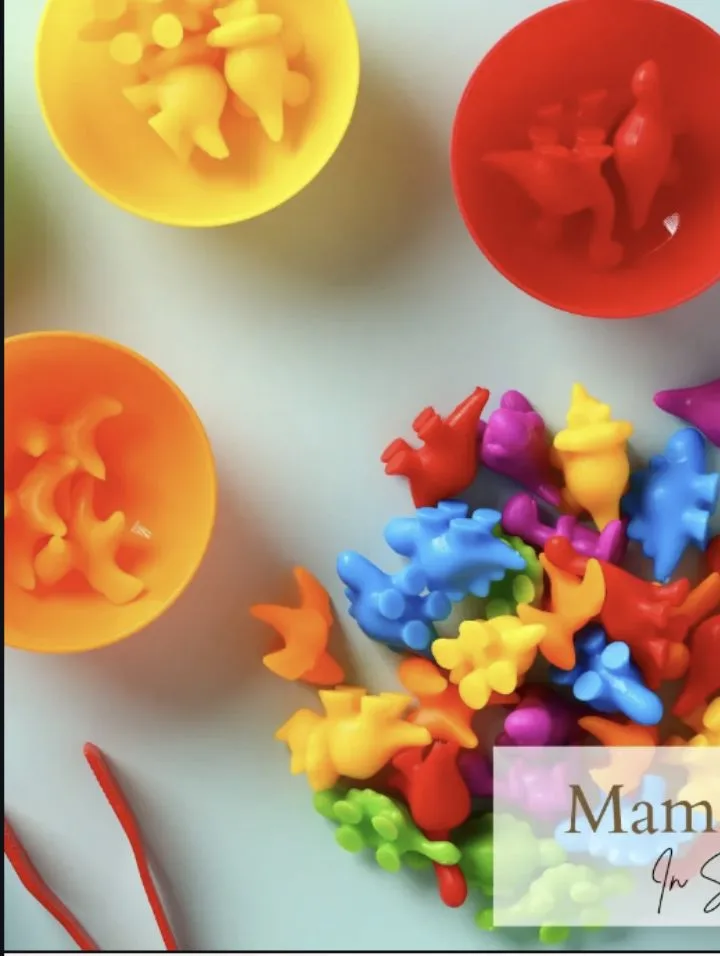
- Sorting buttons, pom-poms or dry pasta by color into a muffin tin
- Tearing scrap paper into small pieces for a collage
- Spooning dry beans from one bowl to another
- Wiping the chalkboard tray with a damp cloth
- Carrying the picture books to the nook and facing them out
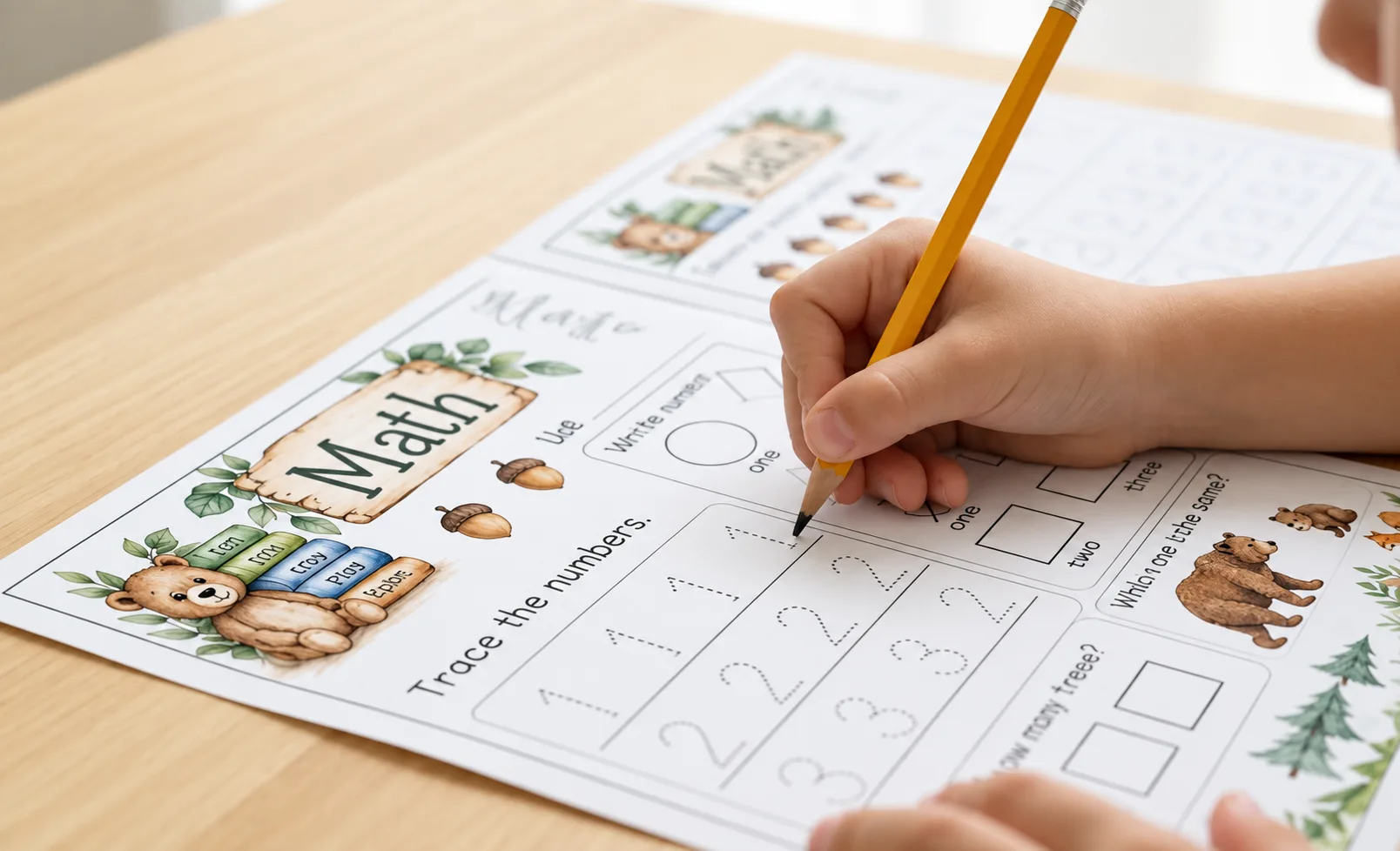
Paper work counts too. A page like Fall Colors: Leaves Are Falling All Around gives him maple leaves to color while his brother does his own letters. For something messier, the Fall Leaf Stamping Printable Activity Pack and the Cotton Ball Ghost Craft are both made for all ages, so my five-year-old can join in the moment he finishes. When your three-year-old is ready for a little sorting, the Pumpkin Size Sort is a good first cut and paste.
What I actually say
Words matter more than I expected. Before I open the older boy's lesson, I crouch down and say it plainly:
"You have your basket. I am going to work with your brother for ten minutes, and then I am all yours. Show me what you made when I look up."
Then I do look up. That is the promise, and it is the whole secret. If he learns that I always look up, he waits. If he learns I forget, he finds a way to be remembered.
I keep my teaching in short pieces so that looking up is easy. A five-year-old can do a letter, a number and a read-aloud in small bites, and between each bite I turn to the younger one, admire his tray, and give him one next thing. It is a rhythm, not a performance.
Put the hardest teaching first
Your three-year-old has a best window, and it is usually early, right after breakfast and a little play. I save the older child's newest, most thinking-heavy work for that window. Anything he can do mostly alone, like coloring, copying or listening to a story in the nook, can wait for later when the little one is tired. I am not always right about this. Some mornings the basket lasts four minutes and I let it be four minutes, and we move to the nook and read together. That is still a good morning.
Let him join in when he wants to
Sometimes my three-year-old wants to sit in on his brother's lesson, and I let him. He holds the counting bears, he says the verse a half-beat late, and he learns far more by listening than I realize. Do not worry that you are letting him cheat. These years are not a race. A boy who feels welcome at the table is already learning to love it.
If you would like worksheets that are ready to print and sized for ages 2 through 7, you will find them in the worksheet shop. Every worksheet is $4.00, or $2.00 for members, and joining is free and includes 38 free printables. When you need to hear from another mama who has a toddler at her elbow too, the members' forum has rooms for the hard days.
A small thing to try tomorrow
Tonight, fill one basket with something simple, like buttons and a muffin tin. Put it where your toddler will sit tomorrow and cover it with a cloth. In the morning, light the candle, read the verse, and tell him what you will tell him. Then begin with your older child, and look up in ten minutes.
He is not in the way of your homeschool. He is part of it. We are asked to lead the little ones gently, the way we are led: "He tends his flock like a shepherd: he gathers the lambs in his arms and carries them close to his heart; he gently leads those that have young." (Isaiah 40:11)