
Tuesday, 9:15, and my three-year-old is a dog today
He was not upset. He was being a dog, padding happily around the stools. My five-year-old was already tracing, pressing so hard the pencil squeaked, and I had one page in front of me and two boys who were not in the same place at all. That is most mornings here. That is also why I stopped trying to finish a worksheet in one sitting.
We use the Math Week 2: Days 1-4 Let's Count to 2 worksheet across four mornings, not one. It is a single page, print at home, US letter. It has three things on it: count objects and circle the group of 2, trace the number 2 four times, and color 2 apples out of four. Three small tasks. Four days. That math is on purpose.
Why one page takes us four days
A three-year-old does not need more pages. He needs the same idea again. Two is not a fact he memorizes, it is a thing he notices, over and over, until it is his. Two shoes. Two hands. Two boys at my table. If I hand him a fresh worksheet every morning I am giving myself something to feel accomplished about. If I hand him the same number for four days, I am giving him time.
So I print one copy for each boy on Monday and I do not put them away. They live in a clipboard in the cubbies beside our big table. We do one piece a day, five to ten minutes, and then we are done and outside or in the sink with soap.
Day 1: counting out loud, nothing on paper yet
On the first day the page stays face down. We count things I carry in from the kitchen. Two spoons, two apples, two eggs out of the carton. I set two of something on the table and ask, "How many?" and I wait. My three-year-old will say "three" cheerfully and be completely at peace with it. I do not correct him with my voice up. I move his finger. "One. Two. Two spoons." Touch and say, touch and say. Then I turn the page over and we only do the circle-the-group-of-2 section. That is it. Two minutes of pencil.
Day 2: tracing, and letting the 5-year-old go first
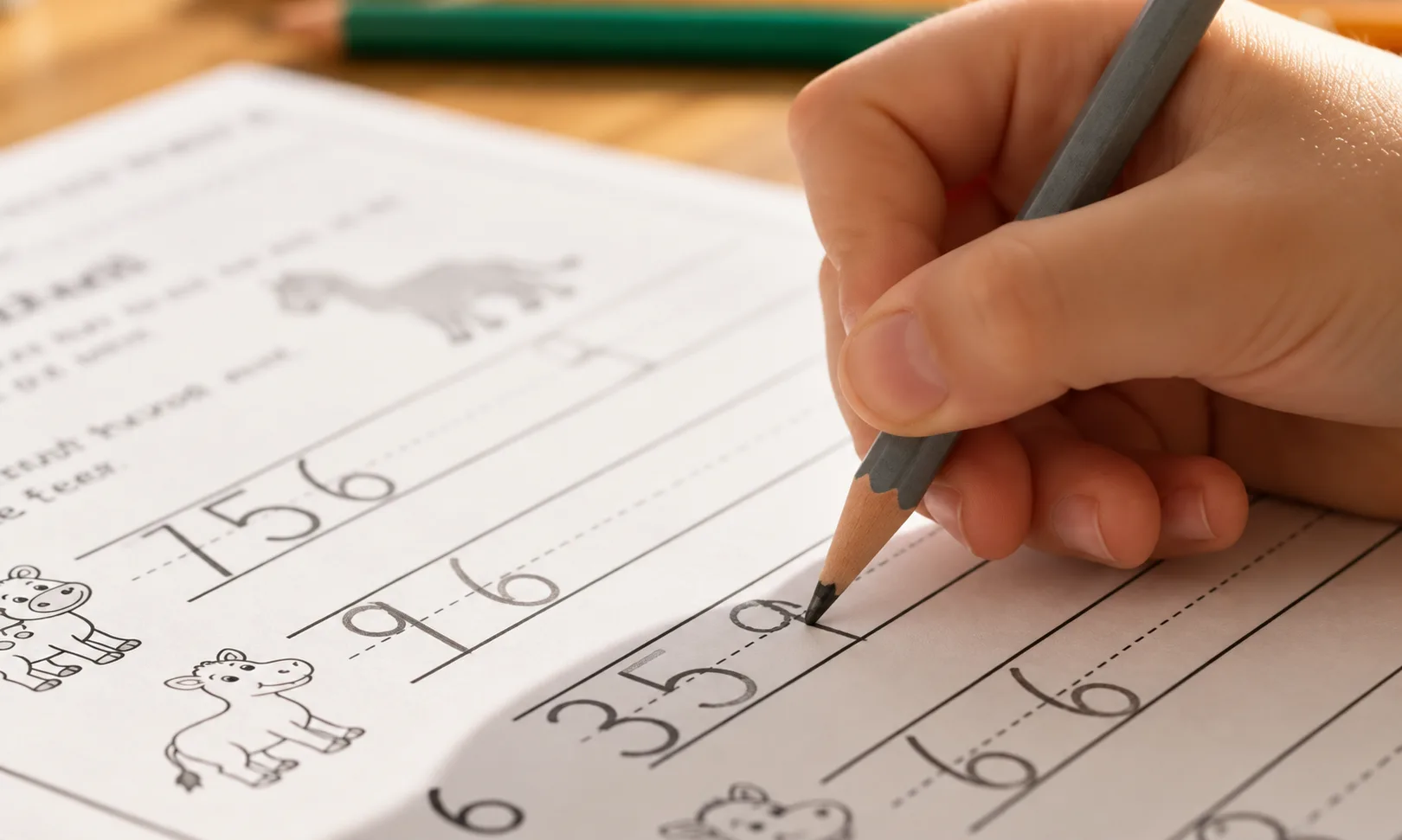
The number 2 gets traced four times. My five-year-old does his cleanly and then he is my helper, which is the real trick. He sits next to his brother and says "start at the top" in a voice that is a very funny imitation of mine. A three-year-old will accept correction from his big brother that he will not accept from me at 9am. I let that happen.
If tracing is hard, we do it in the air first. Big arm, whole body. "Around, and slide." Then finger on the table. Then pencil. Three sizes of the same motion, and the pencil part is last and shortest.
Day 3: the apples, and a conversation about enough
Color 2 apples out of four. This is the part I like best, because it is the first time the number has a stopping point. You color two and you leave two. My boys want to color all four. Of course they do. So we talk about it. "How many did God ask you for? Two. So two get color, and two get to stay white." It sounds small. It is the beginning of obeying an instruction all the way, not most of the way.
We read Genesis 7 sometimes on this day, the animals going in two by two, and my three-year-old walks his fingers across the table in pairs. That takes four minutes and he remembers it for months.
Day 4: no pencil at all
Day four we do not touch the page. We go find twos. Two socks in the laundry. Two windows in the living room. Two ducks if we are lucky at the pond. I ask, "Can you find me two of something?" and then I follow him around the house while he shows me. He is teaching me by the end of it, and that is the whole point. Then I clip the finished page up on our work wall and we are done with the number two, and next week it will be three.
What I say when it falls apart
Some weeks it still falls apart, and that is all right. Here is my actual script, in order, and I use it out loud:
- "Two more, then we stop." Never "finish the page." Name a number he can see the end of.
- "You do one, I do one." I take the pencil and trace a 2 myself. Suddenly he wants it back.
- "Show me with your body." Stand up, count two jumps, sit back down. Movement resets a stuck three-year-old faster than anything I have tried.
- "We are done for today." Said calmly, before tears, not after. Ending early is not quitting. It is protecting tomorrow.
The morning I stopped forcing the last square was the morning our table got peaceful. A half-finished page is not a failure. It is Tuesday.
Setting the table so this works
I put both boys on the same long side of the table so I can reach both pages without standing up. Pencils in a jar in the middle, one crayon cup, nothing else on the table. Not a decoration, not a cup of coffee I will knock over, which I have. If you are working at the kitchen table, clear one end the night before. For two years we did this at the kitchen table, and this past year I finally built our little classroom. If you are still figuring out where school happens in your house, I wrote about setting up a homeschool space that is really just your kitchen, because that is where mine began.
And if you are earlier than this, wondering whether any of it counts as school, the case for teaching them at home and the questions I get asked most is where I would start. Requirements for homeschooling vary quite a bit from state to state, so please check what yours actually asks of you. I keep state law links and the curriculum we lean on in one place so you are not hunting.
After counting to two
When the numbers are going well and my five-year-old wants something that feels bigger, we move to a different subject on the same four-day rhythm. The History Week 1: What Is History? page works the same way, one short passage stretched across a few mornings, and the Delaware and Maryland states page gets colored a little at a time all week. Everything in the worksheet shop is four dollars, or two if you are a member, and becoming a member costs nothing, ever. You also get a weekly rhythm chart, a morning basket guide and a nature-walk list, plus a quiet moderated forum with a room for the hard days, which I read more than I post in.
Four days on one number feels slow. It is supposed to. He is three, and he has time, and so do you.