
Tuesday morning, my five-year-old was coloring Delaware. He had the crayon going in that hard, satisfied way boys color, and he was happy. And I opened my mouth and said, "You know, God made every one of these states, and He made the people in them, and that means we should love our neighbors, and do you know who your neighbor is?"
His crayon stopped. His face went politely blank. I watched a good morning turn into a thing he had to get through.
I have done that more times than I want to write down. I want my boys to know the Lord, so I bolt a small sermon onto the end of arithmetic, and what they learn is that Mama's Bible talk means the fun part is over. That is the opposite of what I am after.
The problem is not Scripture. It is the seam.
When I tack a verse onto the end of a lesson, my boys can hear the seam. There is the worksheet, and then there is the tone change, the slower voice, the eye contact I did not need for counting. A three-year-old cannot name what happened, but he feels it. He knows he has been moved from doing something to being taught something about himself.
Deuteronomy 6 has been sitting with me for about a year now. Talk of them when you sit in your house, and when you walk by the way, when you lie down, and when you rise. That is not a devotional slot. That is a description of a house where God is simply part of the conversation, the way weather is, the way Daddy coming home is. Nobody announces it. It is just there.
So I stopped trying to make a moment and started trying to make a habit of speech.
One sentence, said early, then dropped
Here is the whole method, and it is embarrassingly small. I say one true sentence about God near the beginning of a lesson, and then I let it go and teach the lesson.
Not at the end, where it feels like a bill coming due. At the beginning, where it sounds like context. And then I do not circle back, I do not quiz, I do not say "and what did we learn." If it took, it took.
Some real ones from our table:
- Before the Delaware and Maryland page: "God put people in every one of these states. He knows the names of the ones in Maryland." Then: "Okay, find Maryland."
- Before counting to two with my three-year-old: "God counts. He counts the stars and He knows how many hairs are on your head." He always grabs his head. Then we count apples.
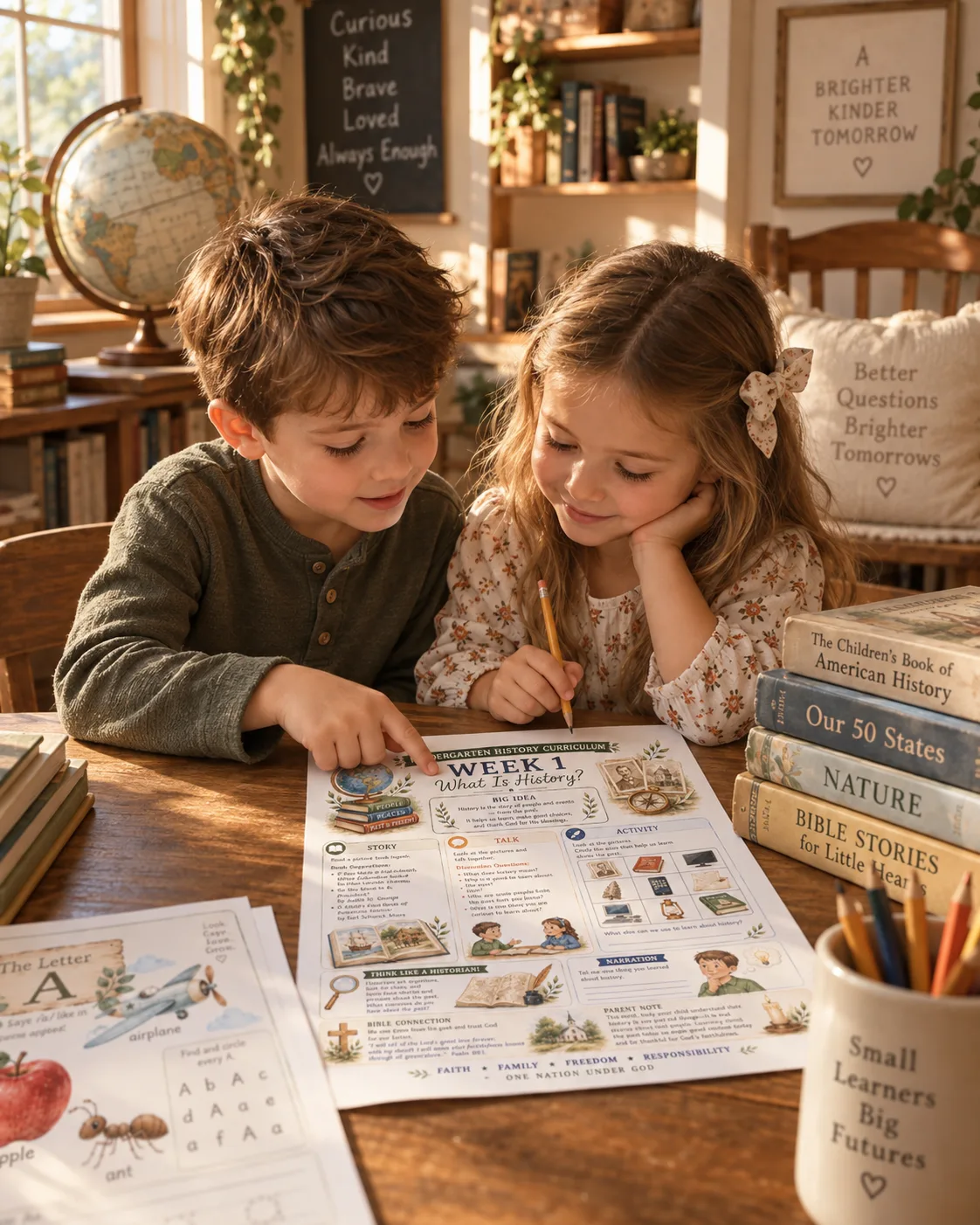
- Before the What Is History page: "History is everything that already happened. God was there for all of it, before there was even a first person." Then we circle the old things.
- Before the personal history page, where he draws himself: "God knew you before you were born. Psalm 139 says He made you on purpose." Then, crayons.
That is it. Eight seconds. No application, no moral, no question that has a right answer he has to produce for me.
Why the ending matters so much
When the God-sentence comes last, it is a verdict. When it comes first, it is a frame. My five-year-old will color for ten minutes inside a frame I set and never notice I set it. If I hand him a verdict, he has to react to it, and a five-year-old's only tool for reacting to a verdict is to go blank or to argue.
Let him ask the second question
The hardest part for me is silence. I say my sentence and I want to keep going, because if I keep going I feel like I am doing my job.
But almost always, if I stop, he asks something. "Did God make New Jersey too?" "Was God a baby?" "Who made God?" Those questions are worth forty of my little speeches, because he is the one holding the shovel.
My script for when I do not know: "That is a really good question. I do not know. Let's ask Daddy tonight, and let's look it up." Then actually do it. My boys are five and three and they can already tell the difference between an answer and a performance.
Where the Bible gets its own time
None of this replaces sitting down with the actual Bible. We read a short passage at the start of our morning, before anything gets printed or traced, and we say one memory verse we are working on. That is the meal. The sentences inside lessons are seasoning. If I only ever seasoned, my boys would never learn that the Bible is a book you open and read, not just a source of Mama's commentary.
The other thing that helps is the room. We keep our verse card taped where the boys eat, not on a shelf where I can see it and they cannot. If you are thinking through how to set up your homeschool space, put the Scripture at kid eye level. Mine read it out loud to each other when I am not even in the room, which is the only proof I have that any of this is working.
If you have already lectured them this week
So have I. Tuesday, over Delaware. You have not ruined anything. Children are far more patient with us than we are with ourselves, and the Lord is more patient still.
Tomorrow, pick one lesson. Say one sentence at the start. Then teach the lesson and keep your mouth shut about it. Do it for a week and see what they ask you.
If you want pages to try it on, the worksheets are here, four dollars each, or two if you are a member. Membership is free and stays free, and it comes with a morning basket guide, a weekly rhythm chart and a nature-walk list. If you are still deciding whether any of this is for your family, the case for homeschooling and the questions I get asked most is where I would start, and the state laws and curriculum we trust page has what I could gather, though requirements really do vary by state and yours is the one that counts. And when a morning falls apart, the members' forum has a room for exactly that. I am in there most days.
He does not need our sermons. He needs us to keep talking about Him at the table, when we sit in the house and when we walk by the way.