
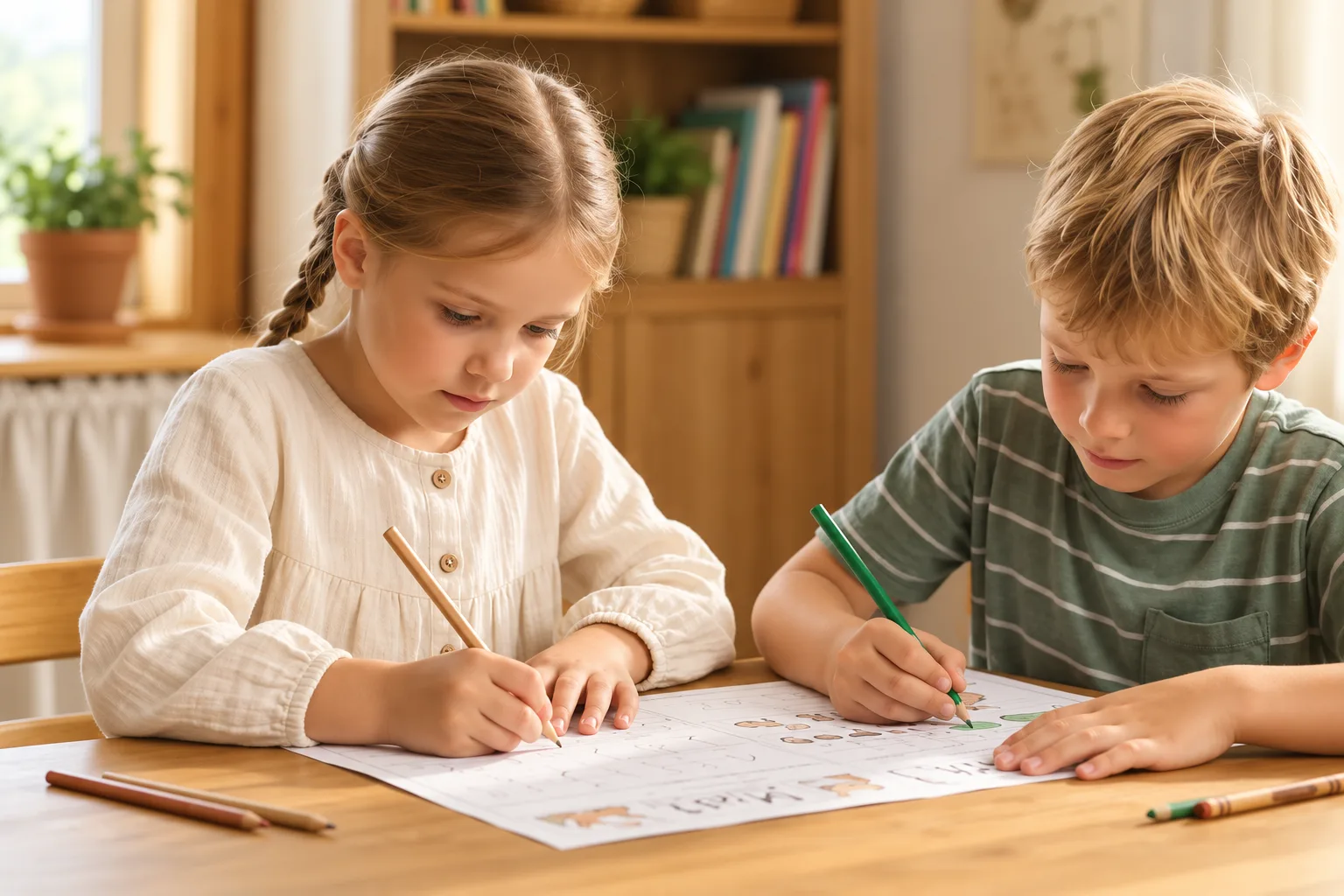
For two years we did this at the kitchen table, and many mornings began the same way. I would sit my oldest down with his pencil, and then I would stand up. The eraser was in the junk drawer. The crayons were in the living room. By the time I sat back down, the quiet start I had hoped for had gently slipped away.
Nothing went wrong those mornings except me getting up four times. That is the whole problem, and a basket fixes most of it.
Why a basket and not a shelf or a bin
Back then the kitchen table was our classroom, which meant it was also where we ate lunch and where somebody's grandmother sat on Sunday. Nothing could live there permanently. These days we school in the classroom I built inside our home, with one big shared table and open cubbies, and the basket came with us. A basket is portable, it has a handle, and a five year old can carry it to the table himself, which matters more than it sounds like it matters.
A shelf across the room means I get up. A bin with a lid means I dig. A basket sitting at my right elbow means everything we need for the next forty minutes is inside my reach, and when we are done, it goes back in its cubby. If you are working at the kitchen table, it can go on top of the refrigerator and the table is a table again.
If you are still deciding where your school things will live at all, I wrote more about how we arranged our space in the post on designing a homeschool classroom when your classroom is the kitchen. The short version is that you need less furniture than the catalogs suggest.
What actually goes in ours
I keep it to what we touch every single morning. Everything else lives somewhere else, and that discipline is the only reason the basket still works six months in.
- Two pencils, sharpened, plus a chunky one for the little guy. Two, because one will roll under the stove.
- One small box of crayons, eight colors. Not the sixty four. Sixty four crayons is a twelve minute conversation about which shade of blue.
- Our Bible and one index card with this week's verse on it. The card is what we actually read from. The Bible is what we open when somebody asks where the verse came from.
- Today's printed page for each boy, already printed. Not the whole week's stack. One page each, facing up.
- A glue stick and safety scissors in a jar. The jar keeps them findable.
- One busy thing for the three year old. Ours is a zip bag of dry beans and a muffin tin, or a magnet board. It is not education. It is the ten minutes I need with his brother.
That is it. No laminator, no flash card collection, no plan binder. I keep the plan on a single sheet clipped beside the chalkboard where I can read it from my seat.
What we deliberately leave out
Markers, because of the walls. Stickers, because they become the whole morning. Anything with a battery. And any worksheet that is not for today, because a stack of six pages tells a five year old he is in for a long sit, and he will tell you what he thinks about that.
The four minute reset, done at night
Here is the part that turned our mornings around, and it is boring. After the boys are in bed, I sit down with the basket for four minutes. I sharpen the two pencils. I pull out yesterday's finished pages and put them in the keep pile. I put tomorrow's two pages in, facing up. I check the verse card. I set the basket on the big table with the handle turned toward my stool.
In the morning I do not make a single decision before breakfast. The decisions were all made last night by a calmer woman.
When I print, I print for both boys at once so the printer only warms up once a week. Right now we are working through the What Is History? page for Kindergarten with my oldest, and his brother gets a page from the Morning Menu bundle, usually the weather and seasons sheet, because he can do it mostly without me. Every page in the worksheet shop is one sided on letter paper, which is the only reason this system does not drown me in paper. If you have not made an account yet, joining is free and cuts every worksheet in half, and the weekly rhythm chart that comes with it is the sheet beside my chalkboard.
Something to try tomorrow morning
Before you fill anything, do this. Set the empty basket on the table, sit down in your chair, and put your hands where they normally go. Now reach for the basket without standing. If you had to lean, move it. That sounds fussy. It is the difference between forty uninterrupted minutes and four trips to the drawer.
Then hand the basket to your oldest and give him a job with words. Mine goes like this: "You are the basket carrier. Bring it to the table, take out your page and your brother's page, and put a pencil by each one." My five year old does this with great seriousness. It takes ninety seconds, it starts the morning with him serving somebody, and it means I walk in and we are already going.
For the three year old, let him choose the color of the crayon box lid or hand out the pencils. Something with his hands, thirty seconds long, at the start.
When the basket stops working
Ours stopped working in February. It had gotten heavy, there were four half finished pages in the bottom, and I was digging again. I dumped it on the floor, put six things back, and threw the rest in a drawer. Twenty minutes. That is the maintenance plan, roughly monthly, whenever it starts feeling like work to open it.
If your mornings feel hard for reasons bigger than a basket, come sit in the members' forum. There is a room for the hard days, and it is quiet and moderated, and nobody there has a perfect table either. If you are earlier in all of this and still wondering whether you can do it, the case for homeschooling and the questions I get most is where I would start, and the resources page has the state law information, which varies quite a bit from place to place, so check where you actually live.
A basket is not a curriculum. It is eleven objects in a wicker box. But it is the thing that keeps me in my seat beside my boys instead of walking back and forth across the room, and staying beside them is most of the work.