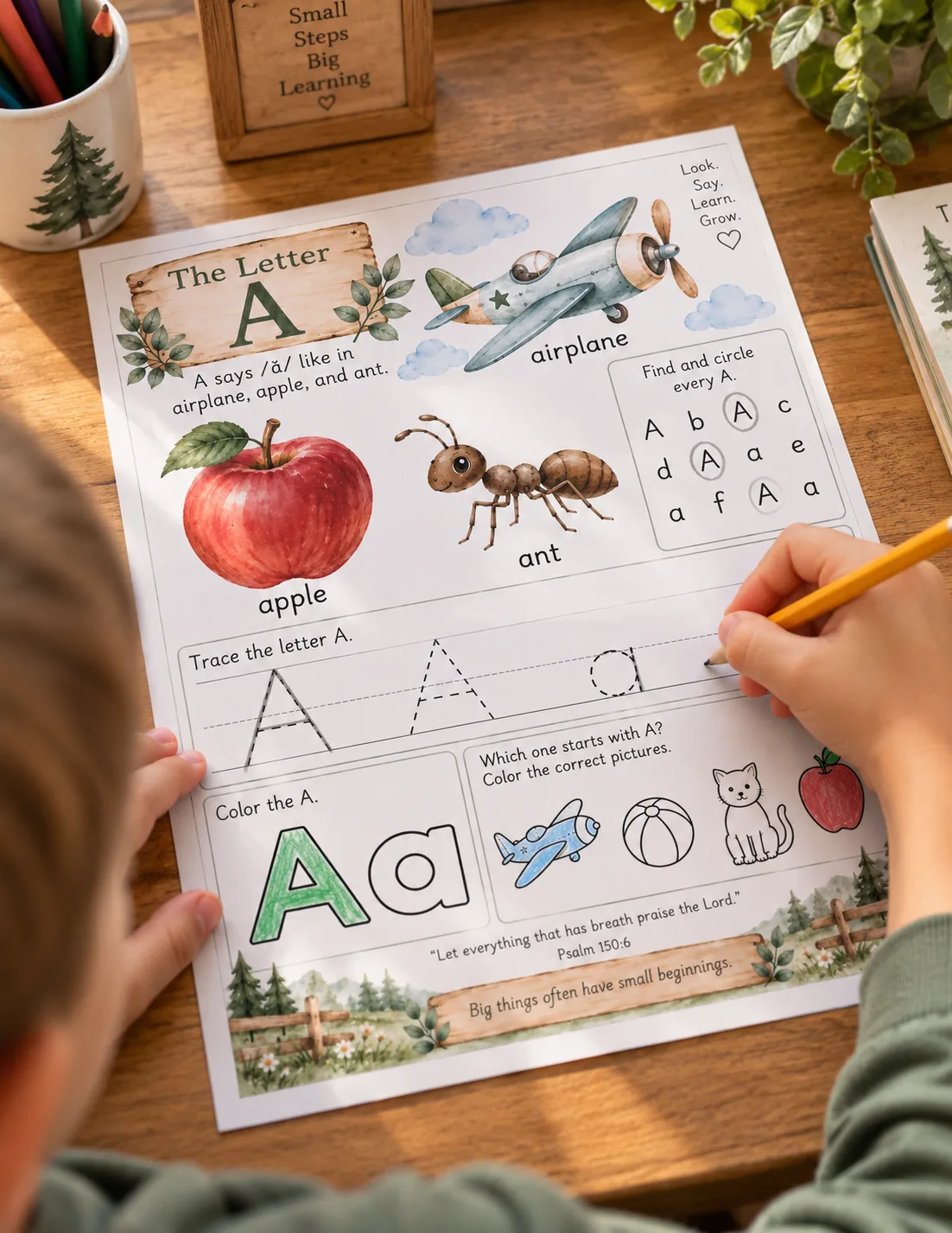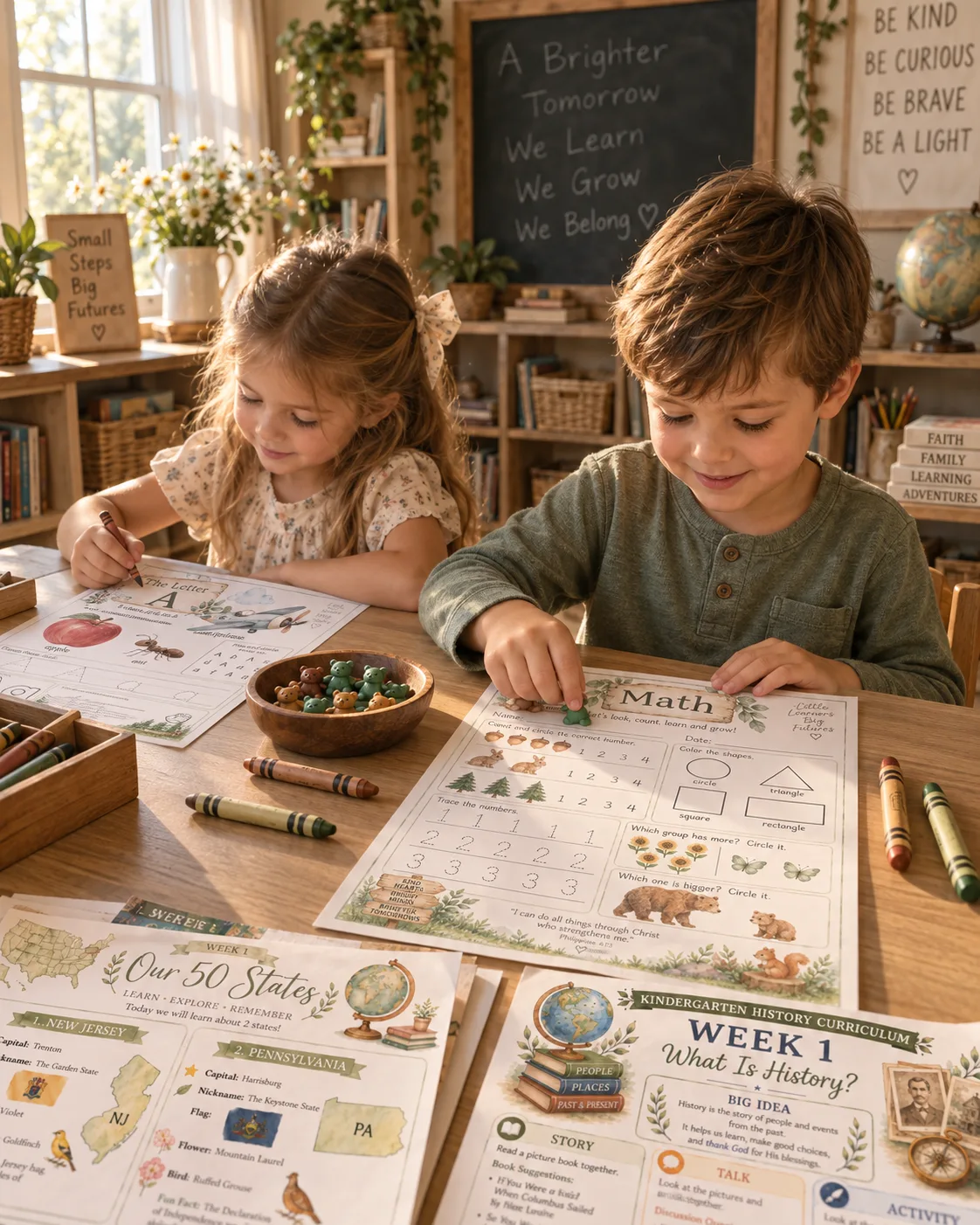

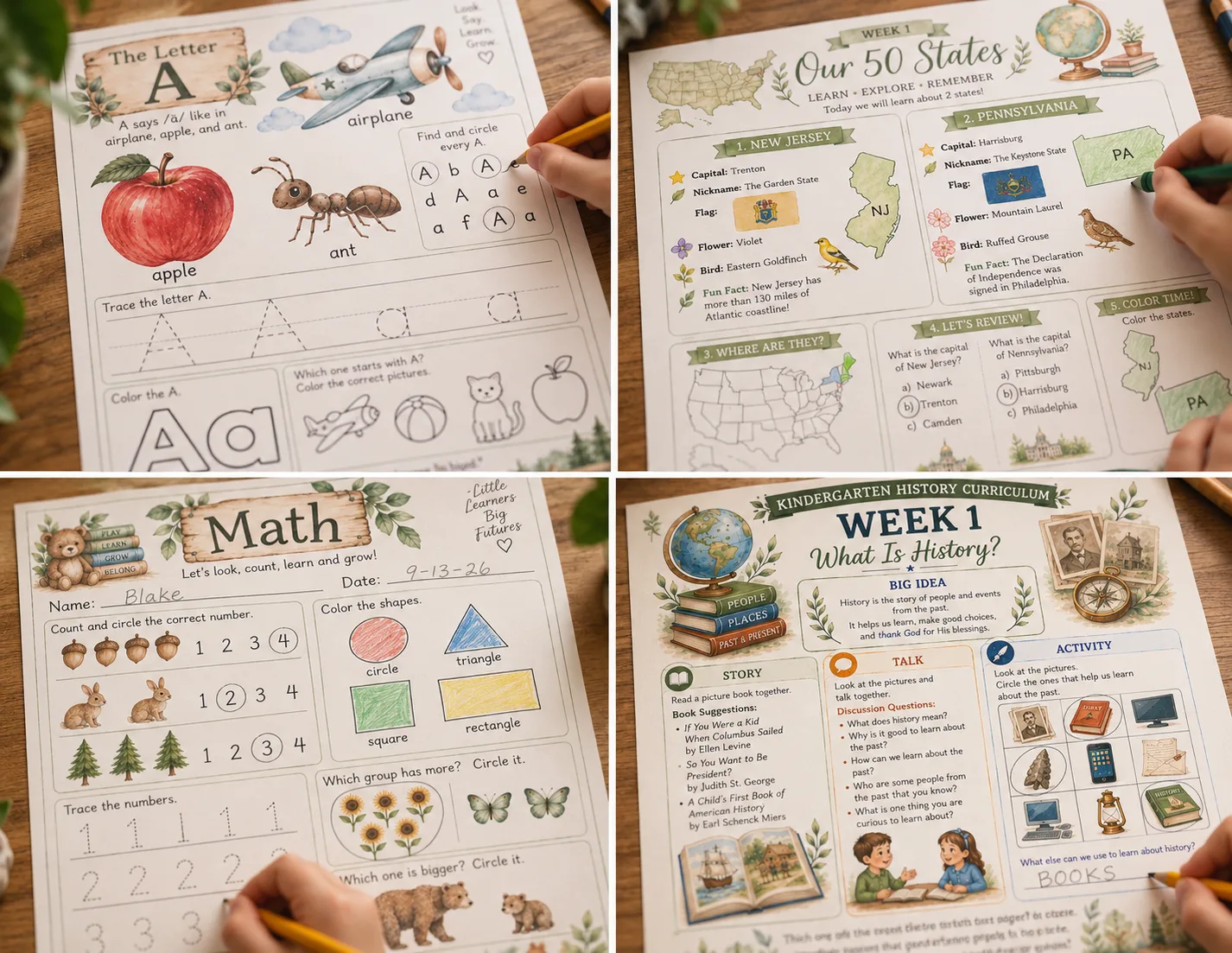
The lamp in the reading nook was already on, the verse was chalked up beside the date, and my five-year-old was sitting on his stool at the big table with the scissors he had picked from the cubby basket himself. In front of him was our Fall Beginning Sounds cut and paste page. That is a good morning to begin a phonics lesson, and it is the one I want to walk you through.
I am not a reading expert. I am a mama teaching a five-year-old and a three-year-old in a room we set up in our home. What I can tell you is how this one page fits into our days, and why I like a cut and paste page for early sounds work.
Why cut and paste works for beginning sounds
A beginning sounds page asks a child to hear the first sound in a word and match it to a letter. That is a listening skill before it is a writing skill. Cutting and pasting keeps his hands busy while his ears do the work, so he is not worrying about pencil grip and letter formation at the same moment. He sorts, he says the word out loud, and he glues it down.
That is the whole reason I reach for it. If your child is not ready to write a letter yet, he can still show you he hears a /b/ at the start of a word.
Before we touch the page: three minutes of listening
I never hand over the paper first. We start with the sounds, with no paper at all. This is the part you can do tomorrow morning with any child from three to seven:
- Say a word slowly, stretching the first sound: "mmmmmmoon."
- Ask, "What sound did you hear first?"
- Have him say the sound, not the letter name. We want mmm, not "em."
- Let him think of another word that starts the same way. Silly answers count.
Three or four words is plenty. If he is guessing, I do not correct him with a long explanation. I just say the word again, slowly, and let him hear it for himself.
How the page goes at our table
Our shared table is counter height with stools, and I sit beside him, not across. I print the page on plain US letter paper, and I cut the page apart ahead of time only if it is a wobbly scissors day. Most days he cuts it himself, and that is good fine-motor practice that does not feel like practice.
Then we go in the same order each time:
- He cuts out one picture at a time, not all of them at once, so the little pieces do not scatter.
- He says the picture's name aloud, and stretches the first sound.
- He decides where it belongs on the page.
- He pastes it only after he has said the sound to me.
That third step is where the learning is, so I leave it alone. If he puts one in the wrong spot, I say, "Let's say it together," and we try again. Usually he moves it himself. Check the listing in the worksheet shop for exactly what is on the page, since I would rather you see it than take my word for it.
What my three-year-old does beside him
My three-year-old does not do the worksheet, and I do not make him. He gets a small desk spot with a basket of his own: a glue stick, a few scraps of paper to tear and paste, and a job that looks like his brother's. Sometimes he plays the sound game with us, and he is surprisingly good at it. He will shout "bbbb-ball!" with his whole chest.
If you want something with a page for the little one, the Fall Colors leaves worksheet is an all-ages coloring page, and the pumpkin size sort cut and paste activity is a preschool sorting page that uses the same scissors-and-glue rhythm, with no letters to know yet.
Stretch one page across the week
One page does not have to be one sitting. This is how we spread it out:
- Monday: the listening game only, with fall words from our nature shelf.
- Tuesday: cut and sort, no gluing yet. Leave the pieces on the page.
- Wednesday: check the sorting, then paste.
- Thursday: clip it to the wall where we hang the week's work, and let him tell his dad about it.
Short sittings keep him wanting more, and I never have to say "just finish it." Ten calm minutes beats thirty tense ones.
If you teach at a kitchen table
For two years we did exactly this at the kitchen table, before the classroom existed. If that is where you are, clear one end the night before and set out the scissors, the glue and the page in a tray or a shallow basket. When everything is in one place, you can sit down and start instead of gathering. Plenty of mamas teach at a table and always will, and it is a real place to homeschool. If you are curious about the room we have now, I wrote about designing your homeschool classroom, but you do not need any of it to do this page.
Price, and joining free
The page is $4.00, or $2.00 if you are a member. Joining is free, forever, and it takes 50% off every worksheet, plus you get 42 free printables. You will also find the members' forum, where other mamas share how their little ones are getting on with letters.
A word for the mama who feels behind
If your five-year-old is not hearing beginning sounds yet, nothing has gone wrong. Some children hear them early and some need a whole autumn of silly words. You are not behind. You are sitting beside your child while he learns that words are made of sounds, and that is holy, ordinary work. The gentle words you say over him in these mornings matter as much as the sounds he learns.