
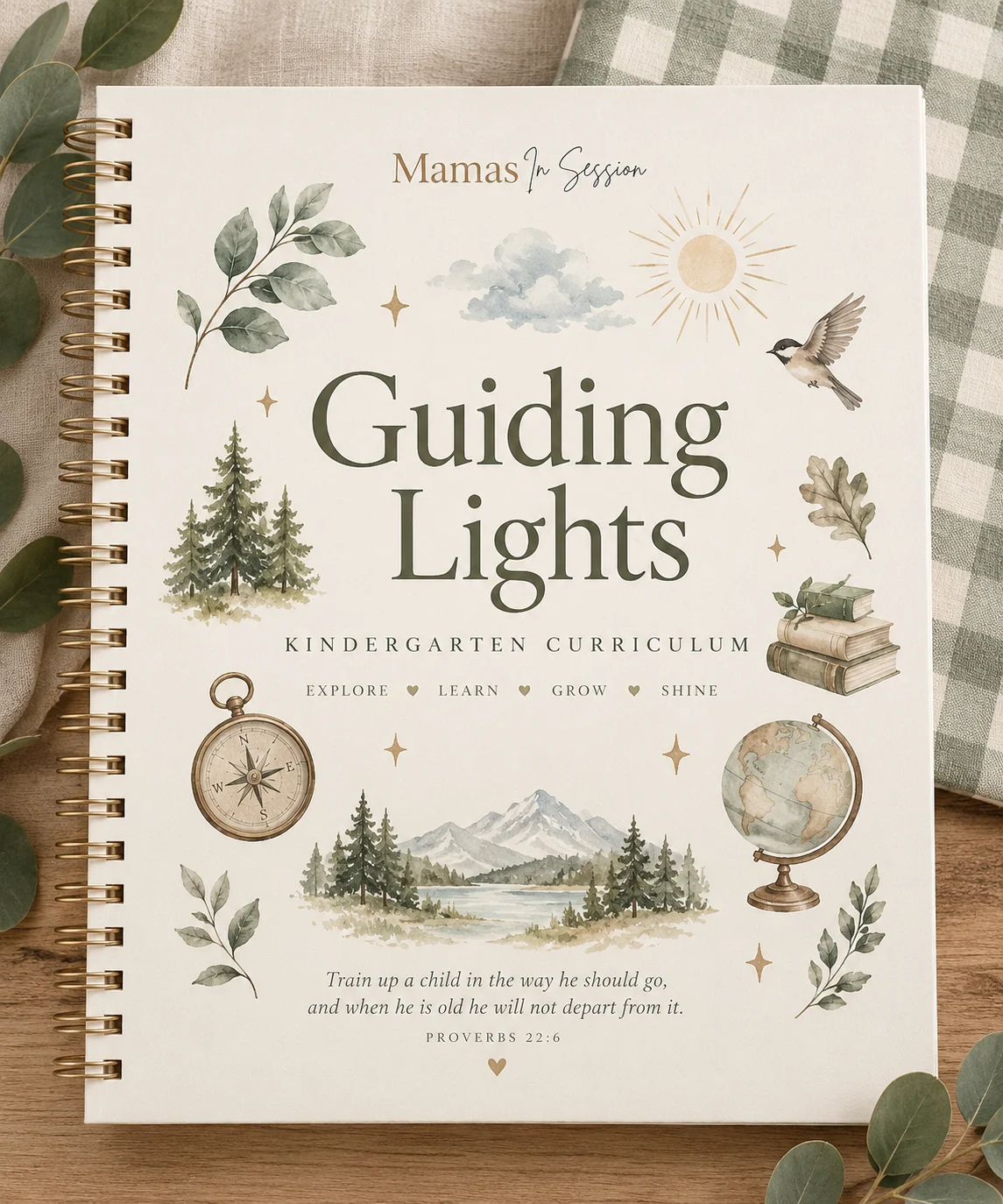
Guiding Lights
A faith-rooted, full-year homeschool curriculum — written at our kitchen table, for yours.
Thirty-six weeks. Five strands. Over 150 pages for your child's grade level, with every lesson opening in Scripture and closing in wonder. Open the book, read the page, teach the morning. No planning, no prep, no pretending you are a schoolteacher.
Because nothing out there was written for a mama at her kitchen table.
Every curriculum I tried in our first two years fell into one of two piles. The first was written for a classroom: thirty children, a trained teacher, a bell. I spent more time translating it than teaching it. The second was so loose it was really a reading list, and left me at 11pm with fourteen tabs open, still not knowing what to do on Monday.
What I wanted was the middle. Something with a spine strong enough that I never wondered what came next, gentle enough that a bad morning did not break it, and honest enough to admit that a three-year-old learns with her hands and not at a desk.
And I wanted Scripture in it. Not bolted on as a Friday devotional, but running through the whole thing, so we teach kindness in the same week we teach the letter K.
Nobody had written it, so we are writing it.

Everything a Kindergarten year needs, and nothing it does not.
Five threads run through all 36 weeks. They are taught together, in one gentle morning, rather than as five separate subjects with five separate books.
Scripture at the heart of the week
Every week opens with one verse, short enough for a three-year-old to keep, and a devotion written for little ears. One virtue a month, carried through every other strand rather than taught on its own.
- 36 weekly verses, chosen to be memorable at 3 as well as at 6
- A short read-aloud devotion for each one
- A monthly character focus with everyday prompts
- A printable memory-verse card for the chalkboard
From tracing an A to reading a sentence
Letter sounds first, blending when they are ready, and never on a timetable that shames a late reader. Sight words in the order they actually turn up in picture books, and a read-aloud list for every week of the year.
- All 26 letters: sound, formation, find-and-circle, tracing
- Blending and first words, introduced once the sounds are secure
- A running sight-word list with review built in
- 36 weeks of read-aloud suggestions any library will have
- Narration prompts, because talking about a book is composition at five
Hands first, then the page
Counting stones, sorting acorns, pouring rice between cups. Number sense gets built with what is already in your kitchen and your yard, and the page comes afterwards to make it stick, never the other way round.
- Numbers 1 to 20: counting, forming, comparing
- One-to-one correspondence with loose parts you already own
- Shapes, patterns, sorting and simple measuring
- Adding and taking away within 10, with objects before symbols
- A hands-on activity for every single page
God's world, one week at a time
Nature study through the seasons, our 50 states two at a time, and history told as the story of real people. Each week has a walk, a craft or an experiment, because a five-year-old remembers what happened to his hands.
- Seasonal nature study with a walk and a collection each week
- Our 50 states, two a week, with capitals, flags, flowers and birds
- History as narrative: who these people were and how we know
- Simple science with kitchen equipment and a bucket
- A nature journal page for every week
The character underneath the curriculum
The part no worksheet teaches. Sharing, apologising, finishing something hard, noticing when somebody else needs help. Woven through the week rather than scheduled, with prompts for the moments that actually come up.
- One virtue a month, with a verse and a family conversation
- Everyday prompts for the moments when it goes wrong
- Gratitude and prayer as a daily habit, not a worksheet
- Simple service ideas a small child can genuinely do
Three quiet hours, Monday to Thursday. Friday is for the walk.
Every week is laid out the same way, so by October you will not need to read the instructions. Nothing here takes a full school day, because a five-year-old does not have one in him.
- Morning basket: candle, verse, picture book
- Letter of the week — sound and formation
- Counting and number formation
- Introduce the exploring topic
- Verse review, sung or said
- Letter practice and sight words
- Hands-on math with loose parts
- Read-aloud tied to the topic
- Morning basket and devotion
- The reading page
- The math page
- The craft or the experiment
- Verse said from memory
- Blending or sight-word review
- Compare, sort or measure
- Narration: tell me about our week
- The nature walk
- The nature journal page
- Collect something for the shelf
- Nothing else. That is the point.
Who this is for, and who it honestly is not.
- You are teaching a child roughly 4 to 6, or a younger sibling alongside one
- You want Scripture woven through the day, not scheduled on Fridays
- You want to open a book and teach, not plan a week every Sunday night
- You would rather your child held something than filled something in
- You have had a hard month and want a spine that survives one
- You need an accredited programme with transcripts or grades. That is not what this is, and we would rather tell you now than later
- You want secular materials with no faith content, which is most of what we do
- You are teaching above 1st grade, for now. Those levels come later
- You want screens, apps or video lessons. This is paper, hands and you
Everything we know so far.
Guiding Lights is still being written, so some answers are honest about what we have not decided yet. We would rather say that than guess.
Put your name down and hear it first.
No date promised, no spam, and one email when Kindergarten is ready. Join free and you also get 50% off every worksheet in the meantime.
Mamas In Session is not an accredited school and Guiding Lights is not an accredited programme. Meeting your state's requirements is your responsibility — our resources page is a good place to start reading.